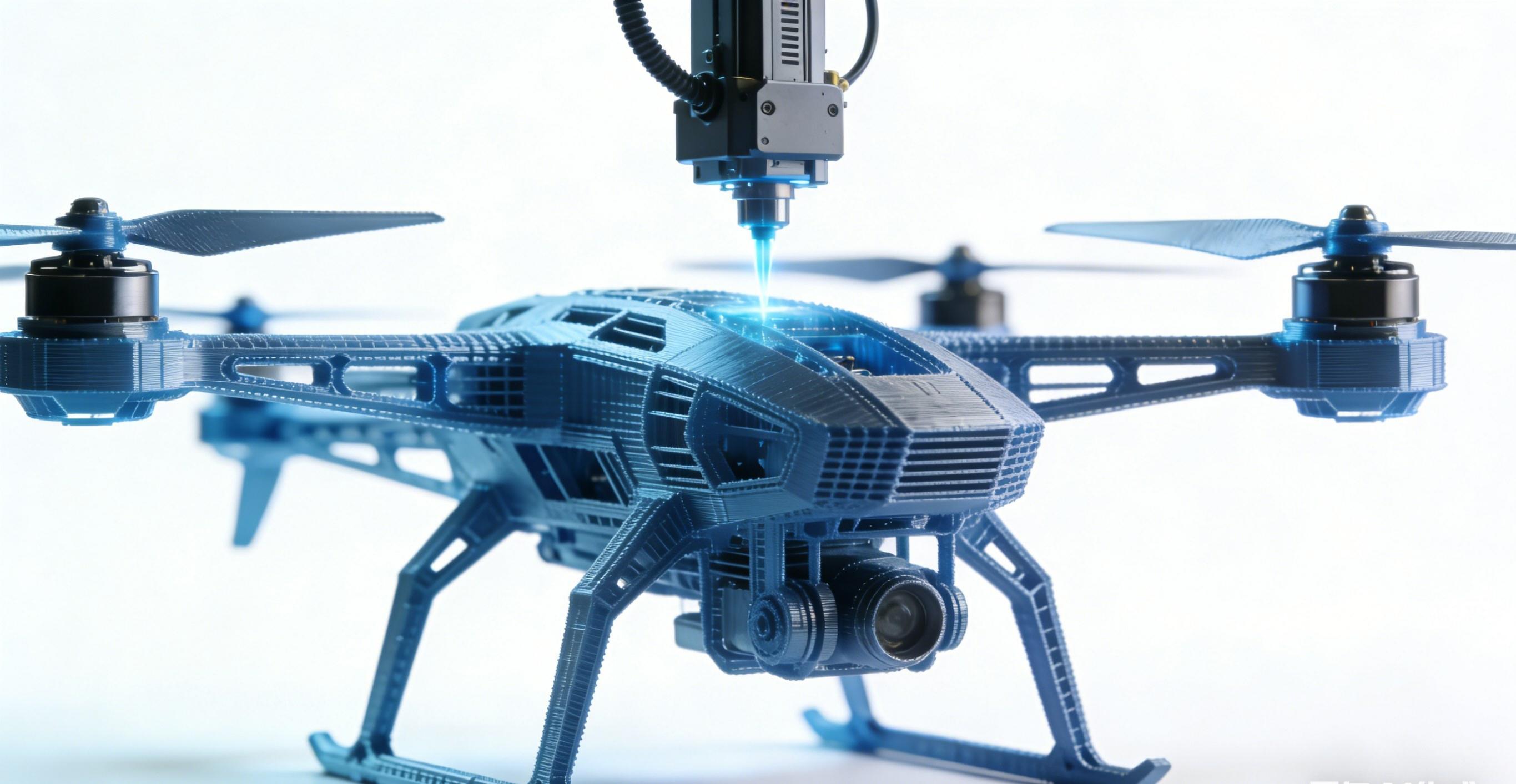
Recently, the MicroSystems Technology Laboratory (MTL) at the Massachusetts Institute of Technology (MIT) announced a groundbreaking scientific achievement: the successful development of the world’s first dedicated platform for 3D printing multi-material integrated motors. This platform enables the direct printing of fully functional linear motors for drones through a single-step process, reducing the total manufacturing time to just three hours and lowering the cost of core materials to as little as $0.50. This innovation completely revolutionizes the traditional manufacturing model and supply chain logic for drone motors.
Traditional drone motor manufacturing involves a cumbersome process that requires the separate machining of components such as stators, rotors, windings, and magnets, followed by dozens of steps including welding, precision assembly, and dynamic balancing. As a result, the development cycle for customized prototypes often takes several weeks, and the cost of small-batch production remains high. The MIT team has extensively modified commercial 3D printers to create a four-module independent extrusion system capable of simultaneously processing three types of materials—filament, pellets, and ink—and precisely depositing five functional materials: dielectric, conductive, soft magnetic, hard magnetic, and flexible. Leveraging micron-level positioning accuracy, this system ensures that the printed motors fully meet performance specifications.
Test data confirms that this 3D-printed motor outperforms traditional products of the same specifications in terms of magnetic field strength and power output. It is ideally suited for core applications such as micro-drives in drones and mechanical joint actuators. Furthermore, it requires no complex post-processing; a single magnetization step is all that is needed before it can be put into service. According to evaluations by authoritative industry experts, this technology has broken down the barriers to integration between additive manufacturing and the motor industry, propelling drone motors into a new era of distributed, on-demand manufacturing. It significantly reduces the time and financial costs associated with small-batch customization and emergency repairs, and is expected to find widespread application in various drone sectors, including aerial photography and surveying, industrial inspections, and medical rescue operations.
Currently, the MIT research team is working full steam ahead to miniaturize the equipment and adapt it for mass production. They plan to integrate the magnetization process into the printing workflow, thereby achieving true “print-and-play” one-stop manufacturing, which will accelerate the commercialization and industry-wide adoption of this cutting-edge technology.
 what's app