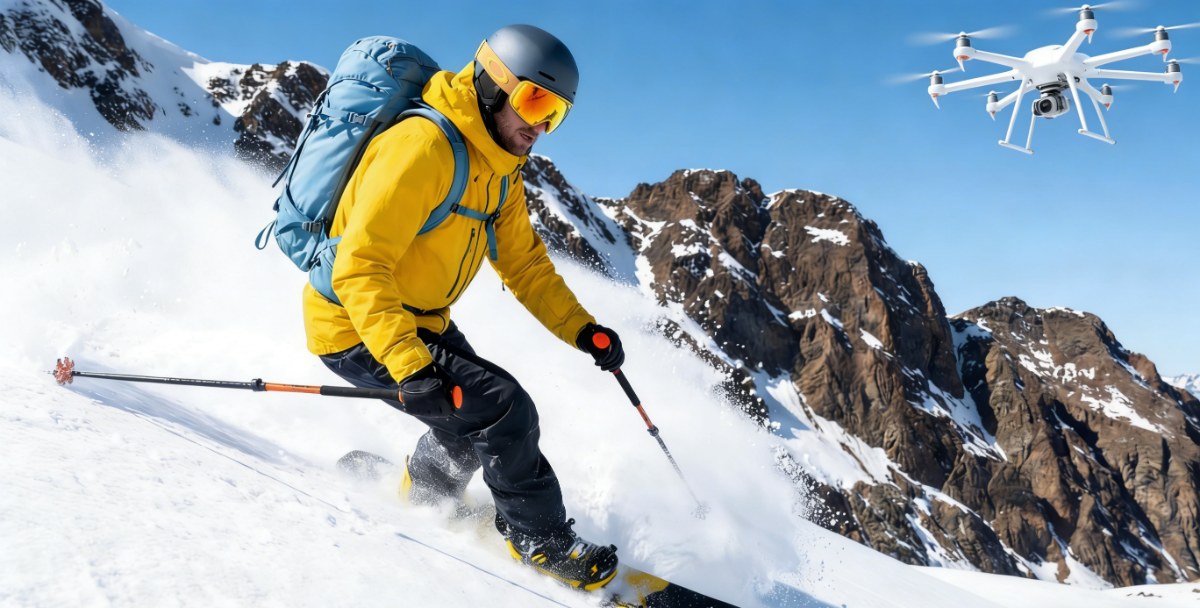
Traditional sports broadcasting relies on fixed cameras, camera cars, and cable-suspended systems (e.g., Spidercam). FPV (First-Person View) drones provide immersive, athlete-perspective footage, capturing dynamic details, speed, and tactical movements—extending the capabilities of conventional camera platforms.
At Milano‑Cortina 2026, FPV drones were deployed on a large scale, covering high-intensity events such as alpine skiing, freestyle skiing, snowboarding, speed skating, Nordic combined, and luge. Fifteen professional FPV teams were responsible for real-time broadcasting, providing audiences with unprecedented immersive views.
Each drone team typically includes:
Pilot: Operates the drone via VR goggles (e.g., Fat Shark, DJI Goggles), receiving real-time first-person footage.
Observer/Spotter: Provides situational awareness to avoid obstacles and reduce risks associated with the limited FPV field of view.
Director: Integrates the FPV footage into the broadcast flow.
This collaborative operation adapts professional FPV racing practices for broadcast applications.
To maintain safety and proximity to athletes:
Weight: ~250 g class, minimizing regulatory hurdles and reducing impact risk.
High Thrust-to-Weight Ratio: Small frames (2.5–3.5 inch propellers, short wheelbase) combined with high-speed brushless motors allow agile maneuvers and precise path tracking.
Custom HD Digital Video Transmission: High-bandwidth, low-latency FPV video links (COFDM or proprietary digital protocols) ensure smooth, broadcast-quality streaming.
FPV drone video must meet broadcast-level standards:
Stable high-frequency transmission (e.g., controlled 5.8 GHz spectrum) to minimize latency and interference.
Distributed reception and forwarding: Ground stations capture, process, and integrate FPV streams with conventional camera feeds for OBS broadcast systems.
Millisecond-level latency control: Ensures seamless switching between FPV and standard cameras in live broadcast.
OBS defined FPV perspective as “movement in sport storytelling”:
Focuses on capturing athlete movements, line choices, and speed control.
Enhances viewer immersion rather than simply adding extra camera angles.
For example:
Alpine skiing: Drones track athletes along downhill paths.
Luge and speed skating: Drones follow turns at high speed.
Freestyle jumps: Dynamic shots emphasize technique and motion trajectory.
Lightweight batteries limit flight time; drones typically cover only short segments before needing battery swaps.
High-density flight schedules require advanced thermal management, power efficiency, and precise flight planning.
Maintaining reliable FPV transmission in electromagnetic-dense environments requires careful spectrum allocation.
Olympic venues coordinated multiple frequency bands to prevent interference with other devices, ensuring uninterrupted broadcast-quality video.
This FPV deployment is a multi-technology integration demonstration, including drones, video transmission, cloud broadcast, and AI-assisted image processing. Future enhancements may include:
Higher-resolution HD/4K/8K FPV transmission
Automated tracking with computer vision for precise athlete following
Edge computing for real-time video processing, AI-enhanced imagery, and low-latency broadcast adaptation
The 2026 Winter Olympics FPV drone deployment represents a new paradigm in sports broadcasting:
Extends traditional camera coverage with immersive, athlete-perspective footage
Combines VR, FPV, and real-time broadcast integration
Provides professional, high-dynamic, immersive live content
This case demonstrates cross-industry innovation in FPV control, 5G/cloud transmission, real-time video systems, and immersive media experiences.
 what's app