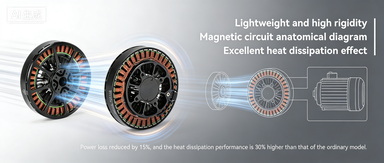
FPV (First Person View) racing drone platforms have rapidly evolved in recent years. Core performance metrics include high thrust-to-weight ratio, fast flight controller response, and sustained high-power output.
High thrust-to-weight ratio: To perform sharp turns, climbs, and dives, minimizing total aircraft weight is critical.
Motor load characteristics: Motors must provide high RPM (typically 2000–3500KV for small racing drones) for rapid acceleration while maintaining efficiency and thermal stability under instant high current.
Weight sensitivity: Even a 1-gram increase can significantly affect agility and battery life.
As a result, ultra-lightweight FPV racing platforms have directly driven motor structural and material weight-reduction innovations.
Reducing motor weight is not just removing material. FPV racing motors must balance the following aspects:
Thermal Management
Racing motors often use outrunner designs, where the rotor shell serves as a direct heat dissipation path.
Reducing rotor and stator mass decreases weight but increases thermal rise, affecting durability and efficiency.
Structural Strength
Lightweighting involves high-strength alloys or carbon fiber materials (e.g., aluminum alloys, magnesium alloys, carbon fiber shells).
The design must ensure rotors do not deform, bearings remain aligned, and magnets do not detach.
Magnetic Material Optimization
Reducing the volume of the stator core or magnets requires precise magnetic circuit design; otherwise, torque output and efficiency suffer.
High-performance NdFeB (neodymium-iron-boron) magnets are commonly used, optimized for pole count and slot design to maintain torque density.
Electrical Performance Matching
Reducing winding wire diameter to save weight increases resistance and heat if not properly designed.
Racing FPV drones often rely on high-frequency PWM and BLHeli firmware for fast motor response, balancing lightweight windings with performance.
Material Lightweighting
Carbon fiber rotor shells: 30–50% lighter than aluminum while maintaining strength.
Magnesium or aluminum-magnesium alloy chassis: Reduce rotor and support weight.
High-energy-density magnets: Reduce magnet volume while sustaining torque.
Structural Optimization
Hollow shaft design: Reduces shaft mass and optimizes rotor inertia.
Honeycomb stator cores: Reduces iron mass while maintaining magnetic flux density.
Multi-layer lightweight windings: Fine wire and multi-layer winding increase power density.
Thermal Management Enhancements
Enhanced outrunner heat dissipation: Fins or high thermal conductivity materials improve short-term power capacity.
Optimized bearings and lubrication: Reduce friction heat while lowering weight.
High-Performance Motor Control
BLHeli/BLHeli_S firmware optimization: Enables faster response and lower current loss.
High-frequency PWM and sensorless control: Reduces weight without sacrificing precision.
Higher power density: As FPV racing motors shrink (e.g., 1106–1306 series), power and torque density demands continue to increase.
Customized motor design: Ultra-lightweight outrunners, multi-pole designs, and low-inertia rotors tailored for specific tracks and drones.
Advanced composite materials: Carbon fiber, ceramic bearings, and lightweight composites will become standard.
Intelligent monitoring and protection: Micro thermal sensors and overcurrent protection allow lightweight designs without compromising safety.
Ultra-lightweight FPV racing platforms drive motor weight reduction innovations that involve materials engineering, structural optimization, magnetic circuit design, winding configuration, and thermal management. Motors must find an optimal balance between high RPM, high torque, low inertia, low weight, and high reliability. This trend is pushing advances in small outrunner motor design and impacting future applications in racing drones, electric models, and other lightweight high-performance small motors.
 what's app