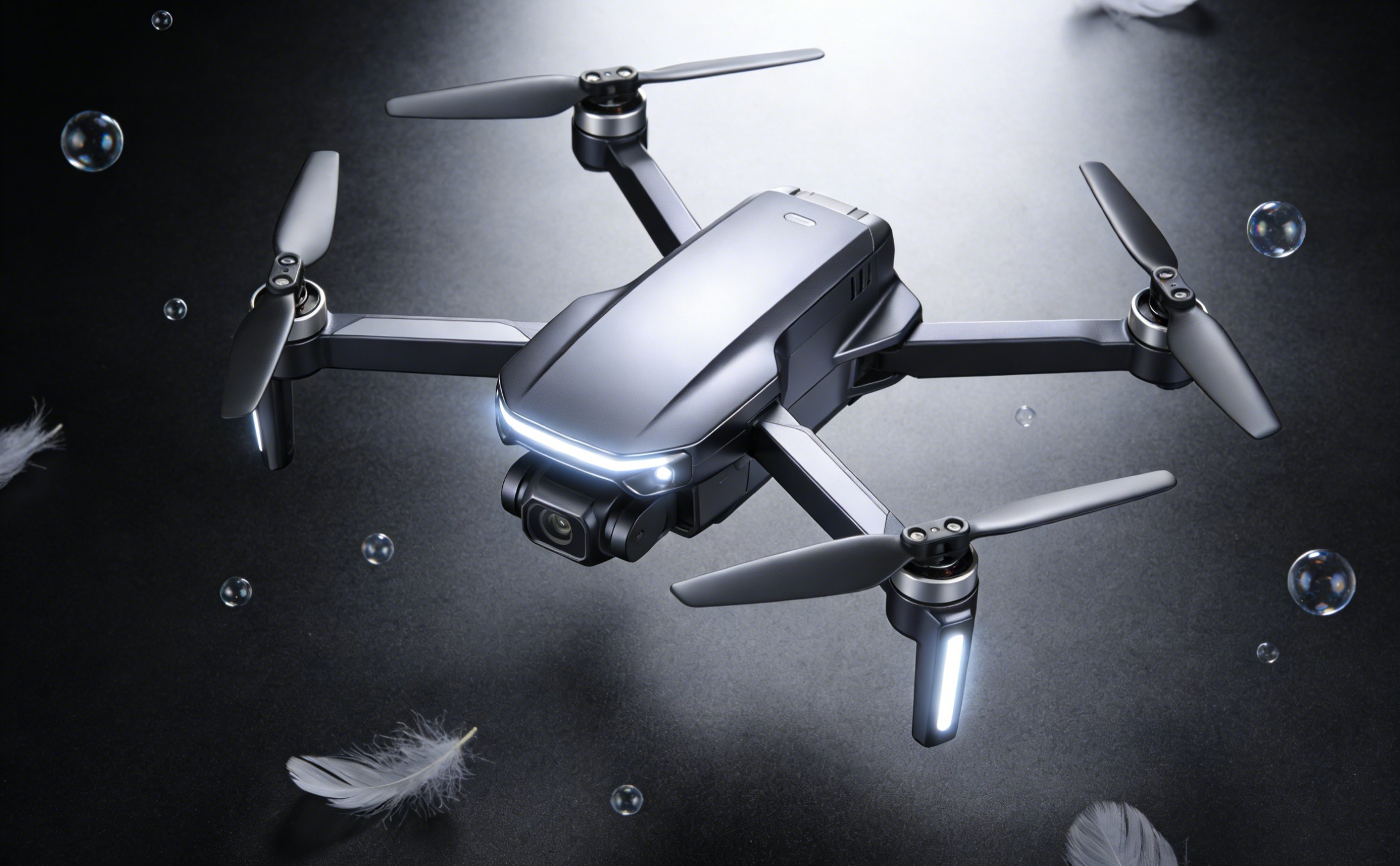
The rapid evolution of FPV drones has pushed FPV motor technology into a new era, where performance is no longer defined solely by speed or thrust, but by a combination of efficiency, weight optimization, and intelligent system integration.
In modern drone engineering, the brushless motor is no longer just a rotating component—it has become the heart of the UAV propulsion system, directly influencing flight time, maneuverability, thermal stability, and overall system reliability.
As FPV drones continue to expand into racing, industrial, and autonomous applications, the future of FPV drone motors is being shaped by three major directions:
1.High efficiency
2.Ultra-lightweight design
3.Intelligent integration
In the early stages of FPV drone development, motor design focused primarily on maximizing thrust and RPM, often at the cost of efficiency and thermal performance. However, as flight requirements become more demanding, efficiency has emerged as a critical factor.
1.A high-efficiency brushless FPV motor ensures:
Longer flight time
Lower heat generation
More stable performance under load
To improve efficiency, engineers focus on multiple aspects simultaneously:
Magnetic Circuit Optimization
By refining magnet placement and flux distribution, modern motors reduce magnetic losses while maintaining strong torque output.
Advanced Winding Techniques
Precision winding reduces electrical resistance and improves current flow, minimizing copper loss.
High-Quality Bearings
Low-friction bearings reduce mechanical loss and improve long-term durability.
Think of an inefficient motor as a car engine that wastes fuel as heat.
A high-efficiency FPV motor, on the other hand, converts almost every bit of electrical energy into useful thrust—making it not only faster, but smarter in how it uses power.
In FPV drone design, weight reduction is not just beneficial—it is essential.
Even a small reduction in motor weight can significantly improve:
Thrust-to-weight ratio
Acceleration performance
Battery efficiency
Modern lightweight drone motors incorporate:
Hollow Shaft Design
Reduces unnecessary mass while maintaining structural strength
Thin-Wall Rotor Bell Structures
Minimizes inertia and improves responsiveness
Advanced Materials
Including high-grade aluminum alloys, magnesium alloys, and even carbon fiber components
Reducing weight does not just make drones faster.
It also allows:
Lower current draw
Reduced thermal load
Improved control precision
In other words:
A lighter motor is not just about speed—it is about system efficiency.
Perhaps the most exciting trend in FPV motor development is the transition toward intelligent systems.
Future intelligent FPV motors will not simply spin—they will communicate, adapt, and optimize performance in real time.
Embedded Sensors
Monitoring temperature, RPM, and current in real time
Telemetry Integration
Providing live data to the flight controller and pilot
Adaptive ESC Control
Dynamically adjusting motor behavior based on flight conditions
Traditionally, motors are passive devices that respond to commands.
In next-generation systems, motors become:
Active participants in flight control
They provide feedback. They influence decisions. They adapt to conditions.
Another key trend is the deep integration of motors into a unified UAV propulsion system, where the motor, ESC, battery, and flight controller are designed as a cohesive unit.
Reduced signal latency
Improved power distribution efficiency
Enhanced system reliability
Simplified installation and maintenance
Imagine early FPV drones as a collection of independent parts, each doing its own job.
Modern drones, however, behave more like a well-coordinated team, where every component communicates and works toward a shared goal:
Maximum performance with minimum energy loss
Imagine early FPV drones as a collection of independent parts, each doing its own job.
Modern drones, however, behave more like a well-coordinated team, where every component communicates and works toward a shared goal:
Maximum performance with minimum energy loss
As motors become smaller and more powerful, thermal management becomes one of the most critical challenges.
High-performance brushless motors generate significant heat due to:
Copper loss
Core loss
Mechanical friction
To address this, modern FPV motors use:
Optimized airflow design in outrunner structures
High-temperature-resistant magnets
Advanced coatings for heat dissipation
A motor that runs cooler is not just more reliable—it is also more efficient and longer-lasting.
Looking ahead, the evolution of FPV drone motors will be driven by the convergence of multiple technologies, including materials science, electronics, and artificial intelligence.
Future systems will feature:
Fully integrated propulsion modules
AI-assisted performance optimization
Real-time health monitoring and predictive maintenance
The future of FPV motors and UAV propulsion systems lies in a delicate balance between efficiency, weight, and intelligence, where each factor enhances the others rather than competing against them.
As technology continues to advance, the brushless FPV motor will evolve from a simple mechanical device into a highly optimized, data-driven, and intelligent component that defines the performance limits of next-generation drones.
In simple terms:
The best FPV motors of the future will not just be faster—they will be lighter, smarter, and far more efficient.
 what's app