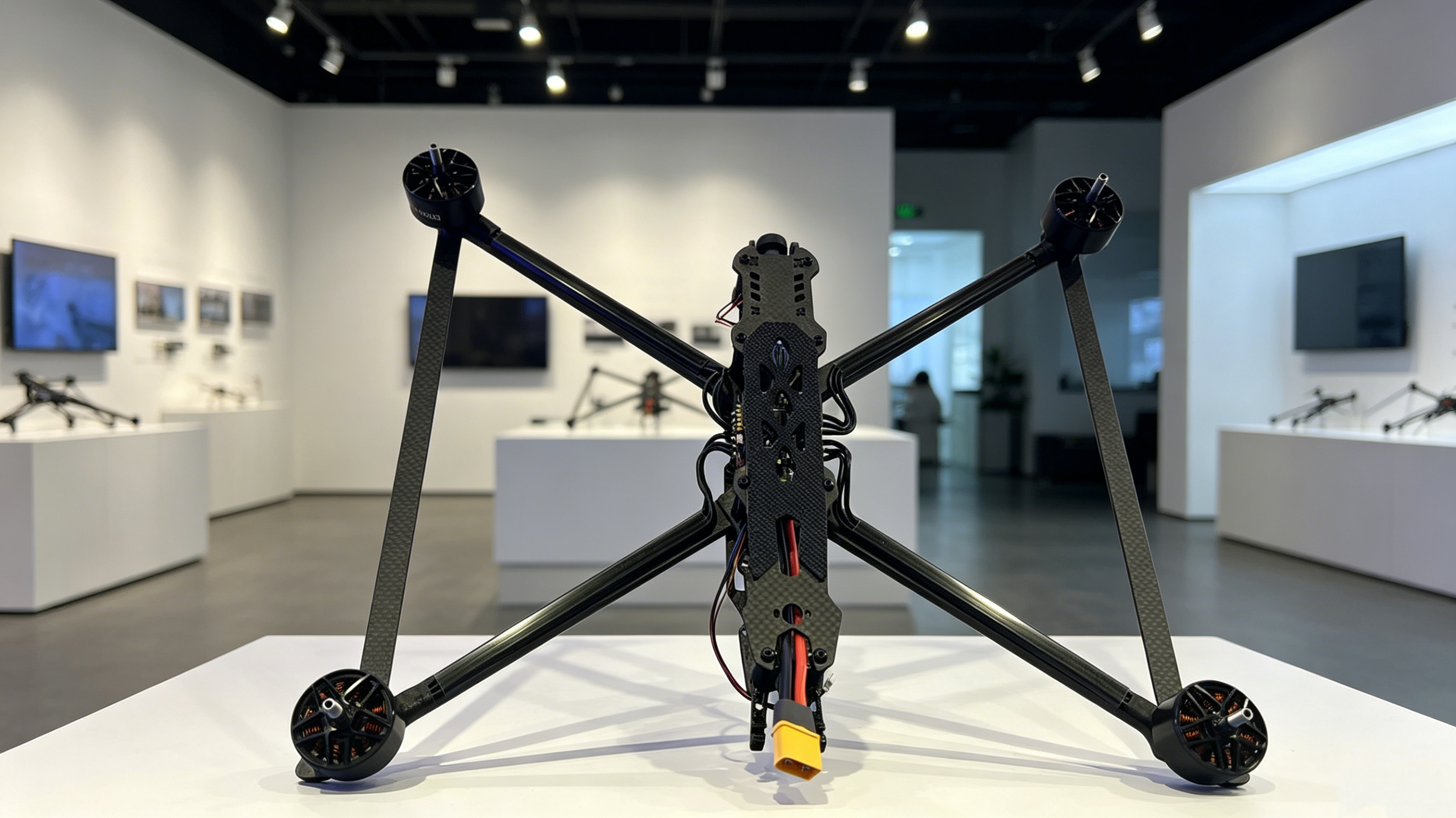
FPV drones are reshaping our world at an unprecedented pace. They are no longer just toys — they have evolved into versatile aerial platforms spanning entertainment, security, military, and rescue operations. At the heart of this transformation lies the power source: the FPV drone motor.
 Entertainment & Competition: The F1 of the Skies
The most well-known identity of FPV drones is that of "Formula 1 in the air." Through first-person-view (FPV) goggles, pilots navigate forests, abandoned buildings, and racecourses at speeds exceeding 200 km/h — delivering an adrenaline-packed immersive experience.
In recent years, FPV racing and freestyle have surged globally, attracting a growing community of young pilots and professionals. These applications demand motors with high RPM, instant throttle response, and lightweight construction. The motor must deliver explosive power for sharp turns, rapid dives, and continuous rolls. The Hobbywing XRotor 2207.5 series is purpose-built for this — with 1780KV for freestyle and 1980KV for racing, renowned for its precise throttle linearity and agile feedback.
 Military Reconnaissance & Precision Strike: Reshaping the Rules of Modern Warfare
FPV drones have fundamentally altered tactical thinking on today's battlefields. With low cost, high maneuverability, and stealth, they have become an indispensable weapon.
Reconnaissance & Surveillance: FPV drones can quickly penetrate hostile areas, streaming real-time high-definition intelligence to command centers.
Precision Strike: Lightly modified FPV drones can carry munitions and be remotely piloted directly into targets. This "kamikaze" tactic has proven highly cost-effective in recent conflicts, challenging traditional armored and defensive systems.
Counter-Drone Interception: Militaries worldwide are actively developing interceptor FPV drones that use their high speed to pursue and neutralize hostile UAVs — building the first line of low-altitude defense
These military applications demand motors with exceptional reliability, resistance to interference, and stable output in complex electromagnetic environments. Motors must also provide enough thrust redundancy to carry light payloads such as cameras, sensors, or munitions.
 Emergency Rescue & Surveying: Lifelines in Disaster Zones
When natural disasters strike — roads collapse, bridges fall — conventional rescue efforts often stall. FPV drones, with their rapid deployment, high agility, and low cost, become indispensable lifelines.
Disaster Search: Following earthquakes, floods, or landslides, FPV drones can quickly survey rubble and hazardous zones, using high-definition and thermal cameras to pinpoint survivors.
Supply Delivery: FPV drones can carry emergency supplies — medicines, food, water — to stranded survivors.
Hazardous Environment Surveying: In nuclear, chemical, or fire zones, FPV drones replace human entry, relaying real-time environmental data to keep responders safe.
These scenarios require motors with extended endurance, smooth low-throttle controllability, and dust/water resistance for reliable operation in adverse weather and complex environments.
 Security & Inspection: Protecting Critical Infrastructure
FPV drones are playing an increasingly vital role in urban security and industrial inspection, dramatically reducing risks and costs.
Pipeline & Powerline Inspection: Equipped with high-definition and thermal cameras, FPV drones can fly along kilometres of pipelines or powerlines, detecting leaks, wear, or foreign objects far more efficiently than ground patrols.
Building & Bridge Inspection: FPV drones can approach high-rise facades, chimneys, or bridge underbellies for close-up structural surveys beyond human reach.
Public Security & Countermeasures: Police and security agencies use FPV drones for large-event monitoring, traffic patrols, and deploying counter-drone interceptors against unauthorized intrusions.
These industrial applications demand motors with high stability, long service life, and environmental resilience (dust-proof, heat-resistant).
FPV motor selection depends heavily on drone size and mission profile. Below is a practical guide:
Drone Size | Application | Typical Motor Model & Specs | Key Requirements |
3-5 inch | Racing, Freestyle, Indoor | 2207.5 (1780KV/1980KV) | Extreme response, high burst power, lightweight |
5-7 inch | Mid-range cruising, Recon | 2807-1350KV | Lightweight, high burst, balanced endurance |
7-10 inch | Large-scale surveying, Counter-interception | 3115-900KV | Lightweight, endurance, thrust redundancy |
10-15 inch | Industrial applications, Heavy-lift inspection | 4214-380KV, 5315-280KV | High payload, high torque, reliability |
15 inch+ | Heavy cargo, Logistics, Manned aircraft | U15XXL KV29 | Ultra-high payload, extreme torque, redundant safety |
Worth highlighting: The 3115 motor (e.g., 3115P-900KV) is emerging as a versatile "all-rounder" — it powers counter-interceptor drones (rapid response, X8 redundancy), logistics and medical transport (efficient cruise, 4kg+ thrust), and survey missions (28-minute endurance, stable sensor payloads). This multi-mission capability makes it highly sought after in military, security, and logistics sectors
The Middle East's unique geography and climate impose specific demands on FPV motors. The extreme desert heat in Saudi Arabia and the UAE requires motors with superior thermal design and heat stability — delivering consistent output even at 50°C+ ground temperatures. Meanwhile, the plains and mountainous terrain across Central Asia and Eastern Europe demand motors with strong power response and climbing capability.
As we highlighted at the outset, FPV drones have evolved from entertainment devices into tools reshaping warfare and rescue operations. Motors capable of withstanding the Middle East's harsh environment — stable across multiple mission profiles — are playing an increasingly crucial role: champions on the racetrack, reliable partners on the battlefield, and lifelines in times of crisis.
FPV drones have evolved far beyond a niche extreme sport — they are now powerful aerial platforms spanning military, security, rescue, and industrial sectors. Behind every flight is a high-performance motor delivering relentless power. From the 2207 motor on a 3-inch racer chasing extreme RPMs, to the U15XXL on a 15-inch heavy-lift platform delivering massive thrust — every technological advance expands the boundaries of what FPV drones can achieve.
For manufacturers, understanding the differentiated motor requirements across these applications and committing to continuous R&D will be key to seizing future market opportunities. For users, choosing the right motor unlocks a drone's full potential.
 what's app