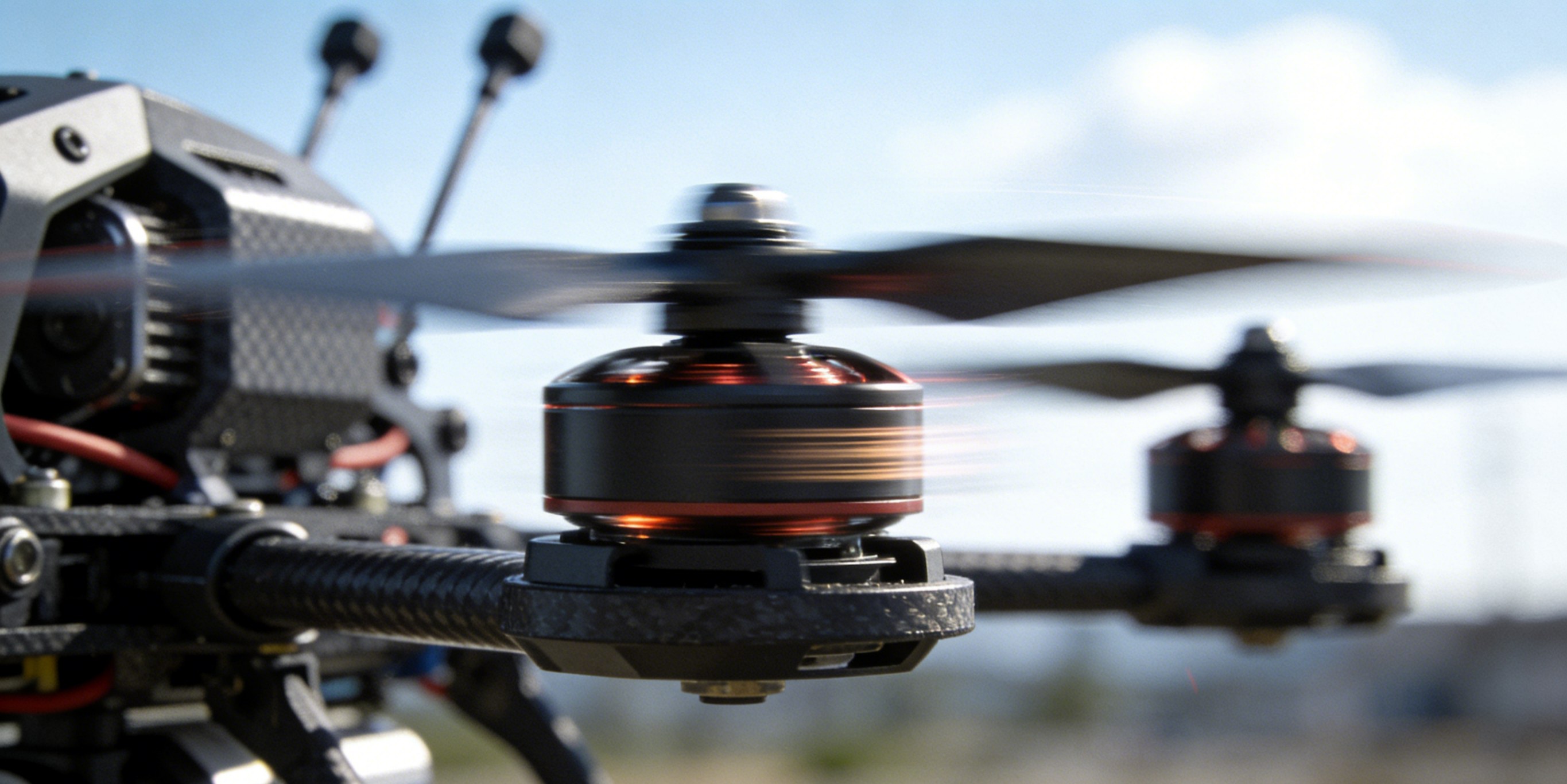
The transition from analog to digital FPV systems marks a fundamental shift in how pilots interact with drones, as modern digital FPV transmission systems now deliver high-definition video with ultra-low latency, dramatically improving situational awareness while simultaneously pushing the FPV motor and propulsion system into far more demanding operating conditions.
What appears to be a simple upgrade in video quality is, in reality, a deep system-level transformation, because once pilots can see more clearly and react faster, they inevitably begin to fly more aggressively, thereby placing significantly higher stress on the brushless motor, ESC, and UAV propulsion system as a whole.
In traditional analog FPV systems, latency was often in the range of 40–80 ms, which created a subtle but critical delay between pilot input and drone response. Pilots learned to compensate for this delay through experience, effectively “predicting” the drone’s movement.
However, with modern digital systems developed by companies like DJI, latency has been reduced to below 20 ms, and in some optimized setups even lower.
This change introduces a fascinating shift:
Pilots no longer need to compensate for delay
Control becomes more intuitive and direct
Reaction speed increases dramatically
But here is the interesting part:
As latency decreases, pilot aggressiveness increases.
Pilots push harder. They accelerate faster. They corner tighter.
And suddenly, the FPV motor is no longer operating in a predictable pattern—it is constantly reacting to rapid, high-frequency control inputs.
With ultra-low latency feedback, throttle input becomes significantly more dynamic, which means the brushless motor is subjected to:
Rapid current spikes
Continuous RPM fluctuation
High-frequency torque changes
Instead of running in a stable operating region, the motor operates in what engineers describe as a non-steady-state dynamic condition, where electrical, thermal, and mechanical parameters are constantly shifting.
In such conditions, motor performance depends heavily on:
Transient response capability
Electromagnetic stability
Thermal resilience
If any of these factors are insufficient, the system may experience:
Oscillation (visible as jitter in flight)
Desynchronization between motor and ESC
Efficiency drop and overheating
In extreme cases, this can lead to complete loss of control.
Digital FPV systems have indirectly accelerated the evolution of ESC technology, which now operates at much higher precision and frequency.
Key technologies include:
DShot1200 protocol for high-speed signal transmission
Bidirectional DShot for real-time RPM feedback
RPM filtering for vibration reduction
These advancements allow the flight controller to “see” what the motor is doing in real time and adjust accordingly.
For these systems to work effectively, the motor itself must be:
Highly consistent
Electrically stable
Mechanically precise
Otherwise, inaccurate RPM data will lead to incorrect filtering and unstable flight behavior.
This creates a feedback loop:
Better ESC → requires better motor → enables more aggressive flight → demands even better motor
As both digital FPV transmission systems and high-power brushless motors operate at high frequencies, electromagnetic interference (EMI) becomes a critical engineering challenge.
Interestingly, this issue is often invisible to users but extremely important in system design.
High current switching in ESC
Rapid magnetic field changes in the motor windings
High-frequency video transmission signals
These factors can interfere with each other, leading to:
Video signal degradation
Control signal instability
Increased system noise
To mitigate EMI, engineers implement:
Shielded motor windings
Low-impedance PCB layouts
High-quality capacitors on ESC power lines
Optimized grounding strategies
In advanced designs, even the motor geometry and winding pattern are optimized to reduce electromagnetic emissions.
One of the most important trends in modern FPV drone development is the shift toward system-level co-design, where motors, ESCs, and FPV transmission systems are developed together rather than independently.
This integrated approach ensures:
Optimal signal stability
Balanced power delivery
Reduced latency across the entire system
In early FPV drones, components behaved like independent musicians playing their own instruments.
In modern digital FPV systems, they function more like a perfectly synchronized orchestra, where:
The motor provides rhythm (power output)
The ESC acts as the conductor (control signals)
The FPV system delivers real-time feedback to the audience (pilot)
If any component falls out of sync, the entire performance suffers.
Looking ahead, the interaction between digital FPV systems and FPV motors will become even more tightly integrated.
Emerging trends include:
Smart motors with embedded sensors
Real-time performance monitoring and telemetry
AI-assisted motor tuning and adaptive ESC control
Fully integrated propulsion modules (Motor + ESC + Control Unit)
These innovations will enable drones to achieve:
Higher efficiency
Lower latency
Greater flight stability
The evolution of digital FPV transmission systems is not just a visual upgrade; it is a catalyst that is fundamentally reshaping how FPV drones are designed and operated.
As pilots gain faster and clearer feedback, they demand more from their drones, and in response, the FPV motor and brushless propulsion system must evolve to handle increasingly dynamic, high-frequency, and high-stress operating conditions.
Ultimately, the future of FPV technology lies in deep integration between vision, control, and propulsion, where motors are no longer passive components but active participants in a highly responsive, intelligent flight system.
 what's app