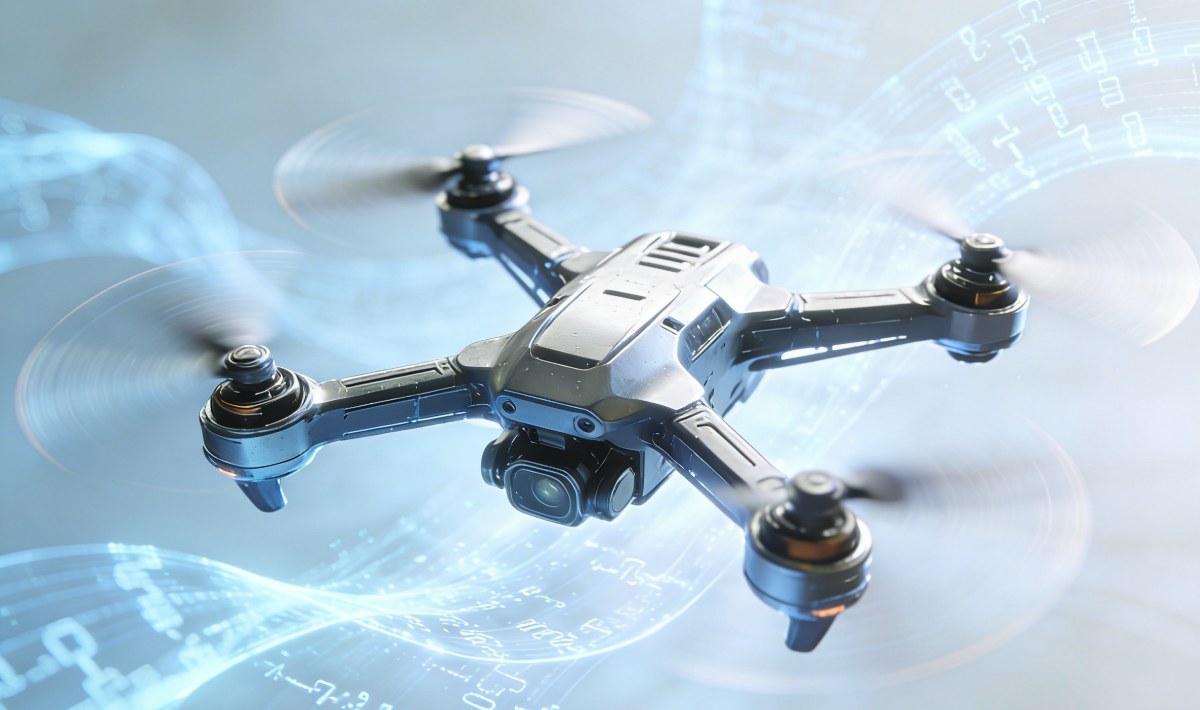
With leading research institutions such as ETH Zurich pushing the boundaries of autonomous FPV racing, drones are rapidly evolving from human-controlled systems into algorithm-driven high-speed autonomous platforms. While this transformation appears to be a breakthrough in artificial intelligence, it fundamentally represents a complete redefinition of the propulsion system—especially the motor.
A simple way to understand this shift is:
Human pilots react after seeing, while AI systems act based on prediction.
This difference dramatically changes the time scale and control frequency, placing entirely new demands on motor performance.
In traditional FPV racing, the control loop follows this sequence:
Vision → Brain processing → Manual input → Radio signal → Flight controller → Motor
The total latency typically exceeds 100 ms, even for highly skilled pilots operating at the limits of human reflexes.
In contrast, AI-based systems operate through:
Vision input → Neural network inference → Control output → Motor execution
Resulting in total latency reduced to:
10–20 ms range
This drastic reduction means that motors must respond almost instantaneously to control signals. Any delay or inconsistency can directly cause:
Trajectory deviation
Control oscillation
Instability at high speed
To meet these ultra-fast response requirements, FPV motors are evolving in several key ways:
Reduced Rotor Inertia
By using lightweight materials (e.g., 7075 aluminum or carbon fiber structures) and thinner rotor designs, motors can accelerate and decelerate more rapidly.
Faster Electromagnetic Response
Optimizing winding resistance and inductance reduces the electrical time constant, enabling quicker torque changes.
High KV with Stability Control
Higher KV ratings provide faster RPM response, but must be balanced with ESC algorithms to maintain controllability.
Core transformation:
Motors are shifting from “continuous power output devices” to “high-speed control response actuators.”
If human pilots can be compared to experienced race car drivers, AI systems are more like:
A tireless, highly aggressive computational driver that constantly seeks optimal trajectories.
Under AI control, FPV drones frequently operate in extreme conditions such as:
High-frequency throttle oscillations
Rapid acceleration and deceleration cycles
High-angle, high-speed cornering maneuvers
In these scenarios, motors no longer operate in stable steady-state conditions, but instead remain in:
Continuously changing non-linear operating regions
This leads to two major engineering challenges:
1. Increased Nonlinear Behavior
Efficiency curves become unstable
Torque-current relationships become less predictable
2. Accelerated Thermal Accumulation
High-frequency current variation increases copper losses
High RPM increases iron losses
Solutions include:
High-temperature-grade magnets (to prevent demagnetization)
Improved cooling paths (leveraging airflow in outrunner designs)
Optimization for high-efficiency operating zones
One of the most fascinating aspects of AI FPV racing is that the system does not control a single motor, but rather:
Continuously coordinates all four motors simultaneously
In essence, drone flight becomes a real-time multi-variable optimization problem.
During aggressive turns, the AI system dynamically:
Increases thrust on outer motors
Reduces thrust on inner motors
Adjusts front-rear balance simultaneously
All within a few milliseconds
Thrust Consistency
All motors must produce uniform performance to avoid yaw errors
Response Synchronization
Minimal latency differences between motors
Predictability
AI models require accurate and consistent motor behavior
This leads to a critical shift:
Motor design must now support algorithmic modeling and control accuracy
This may sound abstract, but it is highly relevant in engineering practice.
During AI training, if a motor exhibits:
Slow response
Output instability
Random variations
The AI model will interpret these as system characteristics
In other words:
The AI adapts to imperfections, but at the cost of reduced performance ceiling.
An unpredictable motor directly limits AI flight performance
This leads to a new design philosophy:
“Model-friendly motors”
Meaning motors that are:
Stable in output
Consistent in parameters
Predictable in behavior
As AI-driven FPV racing continues to evolve, several key trends are emerging:
Motor behavior models embedded in flight controllers
Real-time thrust prediction
ESC dynamically adjusts parameters based on AI demands
Customized motor response curves
Motor design and control algorithms developed together
Full system-level optimization
The real breakthrough of AI FPV racing is not simply that drones are flying faster, but that the entire control paradigm has shifted—from human-centered operation to algorithm-driven high-speed systems.
In this transformation, motors are no longer just power sources; they are evolving into high-frequency, predictable, and model-integrated intelligent actuators. Their performance not only determines flight speed, but also directly defines the stability and upper limits of AI control systems.
In simple terms:
The future of FPV racing is no longer just about better pilots—it is about motors that can “understand” algorithms.
 what's app