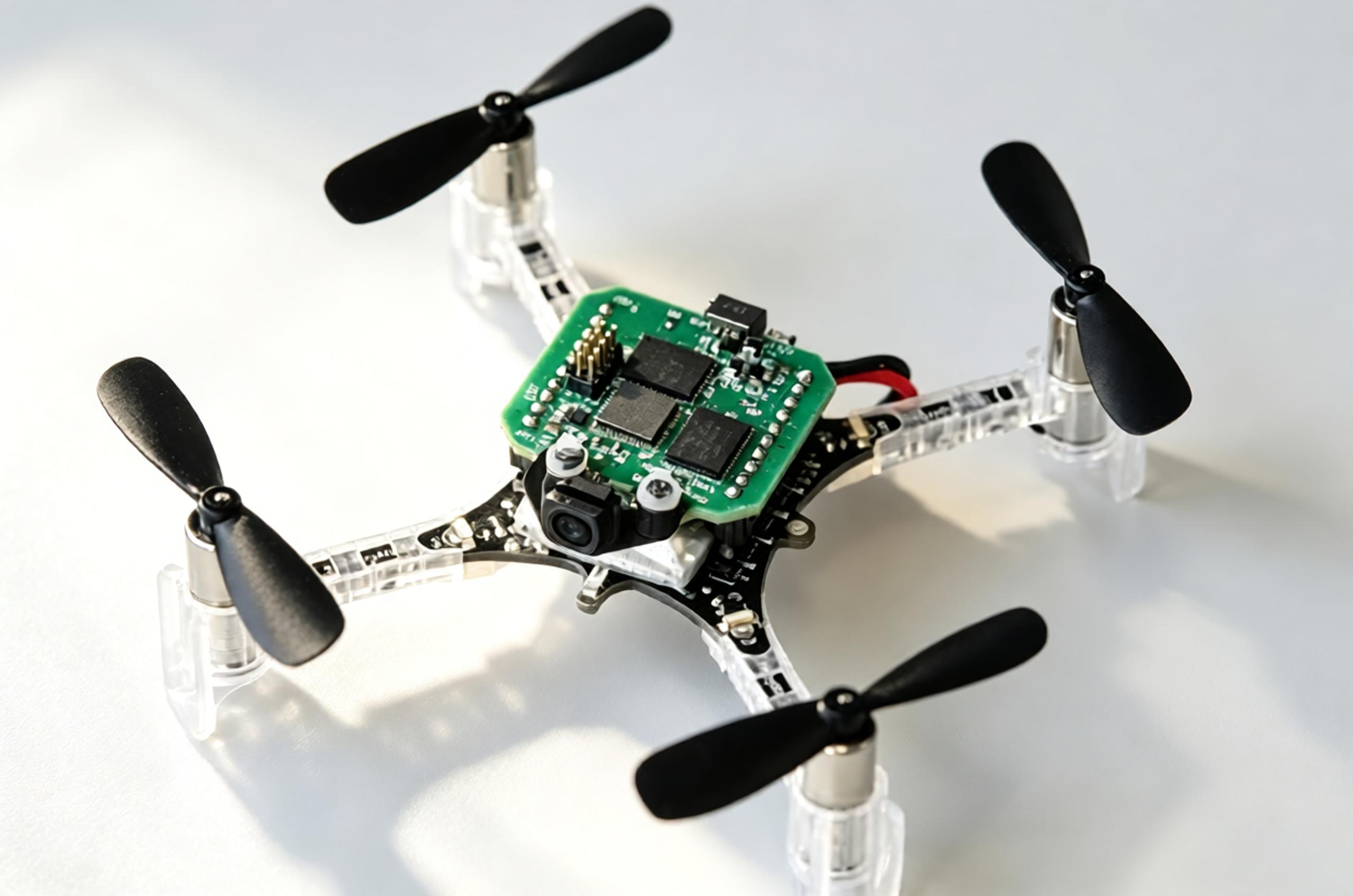
For many years, drones were mainly operated through manual remote control, and the performance requirements for drone motors were primarily focused on basic factors such as thrust output, response speed, and flight stability. However, with the rapid development of artificial intelligence, computer vision, autonomous navigation, and intelligent control algorithms, drones are evolving from simple aerial platforms into highly intelligent autonomous systems capable of perception, decision-making, and independent task execution.
AI-powered drones can now perform complex operations including automatic route planning, obstacle avoidance, target recognition, precision inspection, logistics delivery, and coordinated swarm flight. These advanced applications are significantly expanding the working environment of drones, while also creating new challenges for their propulsion systems.
Unlike traditional consumer drones that mainly require short-duration flight and manual control, autonomous drones must operate for longer periods, carry heavier payloads, adapt to complex environments, and maintain stable performance without continuous human intervention. As a result, drone motors are facing a new generation of requirements centered around higher efficiency, stronger torque output, improved reliability, and greater power density.
Longer Flight Time Becomes a Core Requirement for Intelligent Drones
One of the biggest changes brought by AI technology is that drones are no longer limited to short-term flight operations. Autonomous drones are increasingly being used for industrial inspection, agricultural monitoring, emergency response, and logistics transportation, where they need to complete missions independently over extended periods.
For example, an AI inspection drone may need to continuously monitor power lines, pipelines, or large industrial facilities, while an autonomous delivery drone may need to repeatedly transport materials between fixed locations. In these applications, battery capacity is still limited, making motor efficiency one of the most important factors affecting overall flight endurance.
Compared with traditional drone motors that focus mainly on maximum thrust, future AI drone motors require optimized electromagnetic designs to achieve higher efficiency during continuous operation. Improvements in stator structure, magnetic materials, winding design, and thermal management allow motors to reduce energy loss and generate more thrust from the same amount of electrical power.
This is why industrial UAV platforms increasingly rely on high-efficiency brushless external rotor motors, such as 3115, 4214, and 5315 series motors, which provide an excellent balance between efficiency, torque, and payload capability.
Autonomous Control Requires More Accurate Dynamic Performance
In traditional drone operations, pilots directly control movement through remote transmitters, and the flight controller mainly executes human commands. In contrast, AI autonomous drones must continuously analyze environmental information and make real-time decisions based on cameras, LiDAR, GPS, and other sensors.
During autonomous flight, the control process happens within milliseconds:
The AI system detects environmental changes → the flight controller calculates adjustments → the ESC modifies motor output → the motors instantly change speed to stabilize the aircraft.
This process requires drone motors to provide not only high power output but also extremely accurate and rapid response.
Therefore, modern AI drone motors need to achieve:
Lower rotational inertia for faster acceleration and deceleration;
Stable torque output for precise attitude control;
Smooth operation to reduce vibration and improve sensor accuracy.
For applications such as autonomous mapping drones, FPV inspection drones, and AI tracking platforms, motor responsiveness directly affects flight accuracy and mission success.
Heavier Payloads Require Stronger and More Reliable Propulsion Systems
Artificial intelligence is expanding drone applications beyond photography and entertainment, allowing UAVs to perform professional tasks that previously required helicopters, vehicles, or human operators.
Today, AI-powered drones are being developed for:
Industrial inspection;
Medical and emergency transportation;
Agricultural spraying;
Warehouse logistics;
Search and rescue operations;
Security and defense applications.
Many of these missions require drones to carry additional equipment, including high-resolution cameras, thermal imaging systems, LiDAR sensors, AI computing modules, and communication devices. As payload increases, the propulsion system must provide greater thrust while maintaining efficiency.
This trend is pushing drone motors away from purely high-speed designs toward solutions with higher torque density and stronger continuous output capability.
For different UAV platforms, motor selection is becoming increasingly specialized:
| Drone Application | Recommended Motor Size |
|---|---|
| AI FPV inspection drones | 2207 / 2306 / 3115 |
| 10-13 inch autonomous drones | 3110/ 3115 |
| Industrial inspection UAVs | 4214 / 4715 |
| Heavy payload logistics drones | 5315 / 6218 |
Large external rotor motors provide higher torque at lower RPM, making them especially suitable for industrial UAVs requiring larger propellers and longer flight duration.
Reliability Becomes Critical in Autonomous Operations
Another important direction of AI drone development is autonomous swarm technology, where multiple drones can communicate, coordinate, and complete tasks without direct human control.
In swarm applications, reliability becomes even more important because a single motor failure can interrupt the entire operation. Unlike recreational drones, industrial autonomous systems often operate in challenging environments including high temperatures, dust, strong winds, and long-duration missions.
Therefore, future drone motors must provide improved mechanical strength and environmental adaptability through:
High-quality bearing systems to support long operating hours;
Optimized rotor balancing to reduce vibration;
Stronger materials to maintain structural stability;
Improved heat dissipation designs to prevent overheating.
For industrial UAV manufacturers, motor reliability is no longer just a performance advantage but a key factor determining operational safety and maintenance costs.
More Intelligent Systems Require More Efficient Energy Management
Although AI improves drone intelligence, it also increases onboard energy consumption. Modern autonomous drones require additional electrical power for AI processors, cameras, sensors, communication systems, and data-processing units.
This creates a new challenge:
The drone must provide more intelligent functions while maintaining sufficient flight time.
As a result, future UAV propulsion systems must achieve higher power density, meaning they need to deliver greater output power without significantly increasing motor size and weight.
High-performance external rotor brushless motors are becoming an important solution because they combine compact structure, high torque output, and excellent cooling capability.
For example, motors such as BGS 3115, 4715, and 5315 series can provide different power levels for applications ranging from intelligent FPV platforms to heavy-duty industrial drones.
From Mechanical Components to Intelligent Propulsion Systems
In the future, drone motors will no longer function only as mechanical power sources. With the development of intelligent control systems, motors may integrate additional monitoring and diagnostic functions, creating a complete system combining:
Motor + Sensor + Data Feedback + AI Control
Through real-time monitoring of temperature, current, vibration, and operating conditions, intelligent motor systems can predict potential failures, optimize energy consumption, and improve overall UAV reliability.
This means the competitiveness of drone motors will no longer depend only on traditional specifications such as KV rating, thrust, and weight. Instead, manufacturers will need to focus on comprehensive performance including efficiency, durability, intelligent compatibility, and long-term operational stability.
Artificial intelligence is reshaping the future of unmanned aerial systems and creating new expectations for drone propulsion technology. As drones become more autonomous, their motors must evolve from simple power components into highly efficient, reliable, and intelligent propulsion systems.
The future of drone motors will focus on:
Higher energy efficiency for longer endurance;
Greater torque density for heavier payloads;
Faster response for autonomous control;
Stronger reliability for industrial operations;
Better integration with intelligent flight systems.
From FPV autonomous drones to industrial inspection UAVs, heavy-lift logistics platforms, and future AI drone swarms, advanced brushless external rotor motors will become one of the most critical technologies supporting the next generation of intelligent flight.
AI makes drones smarter, but advanced motors make autonomous flight possible.
 what's app