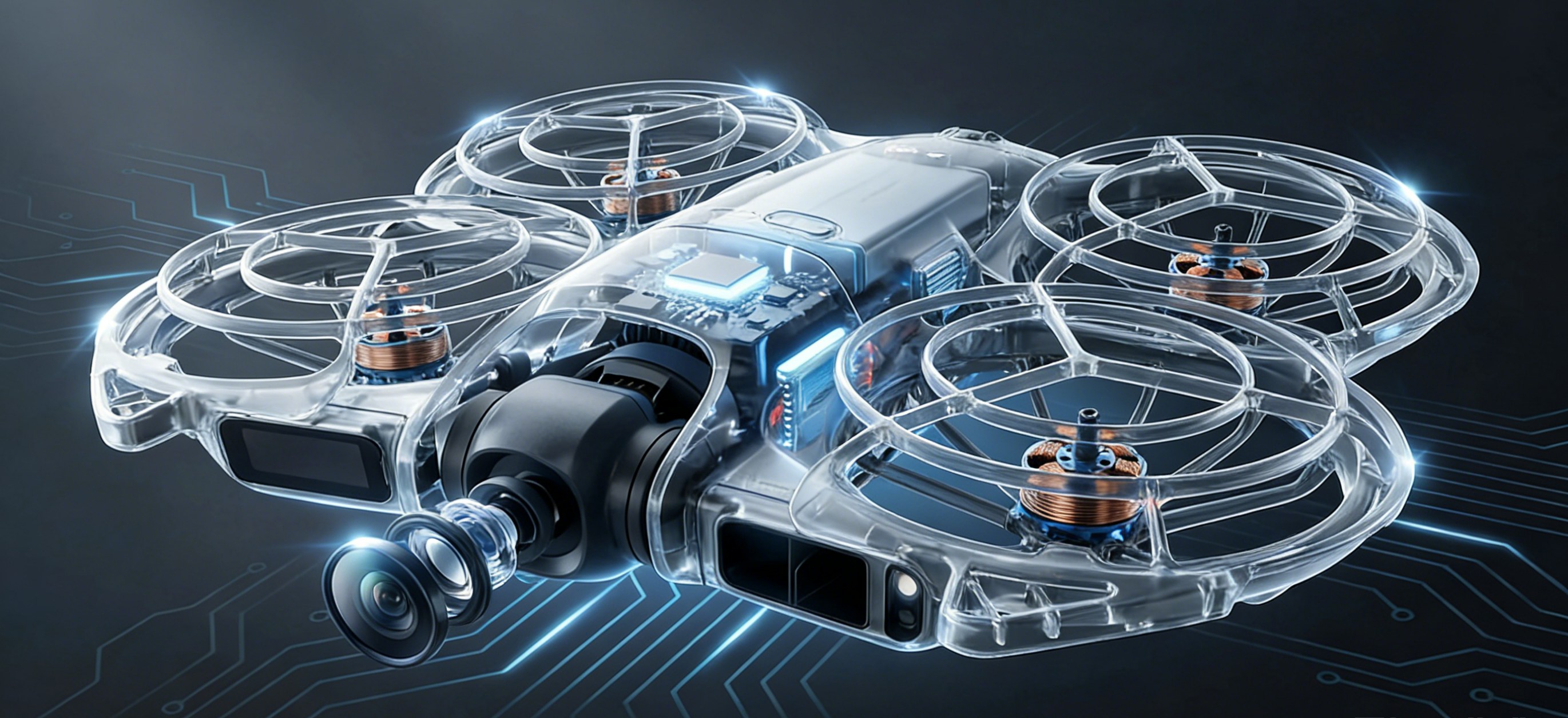
Although an FPV motor and a standard drone motor may appear nearly identical in terms of their external structure, as both are compact brushless motors designed to drive propellers within a UAV propulsion system, the underlying engineering philosophy, performance priorities, and real-world operating behavior of these two motor types differ significantly, ultimately leading to completely different flight characteristics and application scenarios.
At a glance, they look the same.
In reality, they are not.
In essence, while FPV motors are engineered to deliver rapid throttle response and aggressive maneuverability under highly dynamic flight conditions, standard drone motors are designed to provide stable, efficient, and predictable performance over extended flight durations.
Different goals. Different behavior. Different results.
The most fundamental distinction between an FPV drone motor and a standard UAV motor lies in their design objectives, as FPV motors are specifically optimized for high-speed responsiveness and instantaneous power delivery, whereas standard drone motors are engineered with a focus on maintaining stable thrust output and maximizing energy efficiency during prolonged operation.
This divergence in design philosophy means that FPV motors must handle rapid changes in throttle input and operate effectively under constantly fluctuating loads, while standard drone motors are expected to function within relatively stable operating conditions where smoothness and consistency take precedence over raw acceleration capability.
Fast changes. Constant adjustments. Continuous stress.
To better conceptualize this difference, one may consider FPV motors as analogous to high-performance racing engines that prioritize acceleration and responsiveness, whereas standard drone motors resemble endurance-oriented systems designed for efficiency, durability, and long-term stability.
One of the most technically significant differences between these two motor types is the KV rating, which defines the rotational speed of the motor in terms of revolutions per minute per volt under no-load conditions and serves as a key indicator of how the motor behaves in different flight scenarios.
FPV motors typically operate within a high KV range, often between 1800KV and 2800KV or higher, enabling extremely rapid RPM increases and aggressive throttle response that are essential for racing and freestyle flight.
High speed. Instant reaction. Explosive output.
In contrast, standard drone motors generally feature much lower KV values, typically ranging from 300KV to 1000KV, allowing them to generate higher torque at lower rotational speeds and efficiently drive larger propellers.
Stable output. Smooth thrust. Predictable behavior.
As a result, FPV motors are designed to spin smaller propellers at very high speeds, while standard drone motors drive larger propellers more slowly to optimize thrust efficiency and reduce energy consumption.
A clear trade-off: speed or efficiency.
Another critical distinction lies in the balance between torque output and responsiveness, as FPV motors prioritize rapid changes in rotational speed rather than sustained torque production, allowing them to react almost instantaneously to throttle inputs and maintain precise control during aggressive maneuvers.
Instant acceleration. Immediate correction. Constant adjustment.
Standard drone motors, by contrast, are designed to deliver higher torque levels in a controlled and stable manner, enabling them to support heavier payloads and maintain consistent thrust output over extended periods without significant fluctuation.
From an engineering standpoint, this difference reflects a contrast between dynamic response performance and steady-state efficiency, where FPV motors excel in rapid transitions while standard drone motors excel in maintaining equilibrium.
Despite both motor types commonly adopting an outrunner motor configuration, their internal structural design differs significantly in terms of stator size, rotor mass distribution, and rotational inertia, all of which directly influence performance characteristics.
FPV motors are typically built with smaller stators, such as 2207 or 2306 configurations, combined with lightweight rotor bells and thin-wall structures that minimize inertia and enable rapid acceleration and deceleration.
Lightweight. Compact. Highly responsive.
In contrast, standard drone motors often feature larger stators, such as 3510 or 5010 configurations, along with heavier rotor assemblies and stronger magnetic circuits, which allow them to generate higher torque and maintain stable thrust output.
Heavier. Stronger. More stable.
Agility vs stability, engineered into the structure itself.
Efficiency plays a fundamentally different role in the design of FPV motors compared to standard drone motors, as FPV systems prioritize peak performance and responsiveness, while standard UAV systems are optimized to minimize energy consumption and extend flight duration.
In FPV applications, motors operate under highly dynamic conditions involving frequent acceleration and deceleration, which leads to higher current draw and increased thermal stress.
High load. High current. High demand.
Conversely, standard drone motors operate within a more stable efficiency range, where energy loss is minimized and thermal buildup is controlled, allowing significantly longer flight times.
Lower load. Lower stress. Longer endurance.
Short bursts vs long missions.
The thermal characteristics of FPV motors and standard drone motors further highlight their differences, as FPV motors are subjected to rapid temperature fluctuations and must withstand short bursts of intense heat generated by aggressive flight patterns.
Heat spikes. Fast cycles. Extreme conditions.
Standard drone motors, in contrast, operate under more stable thermal conditions, where heat generation is gradual and predictable, allowing for more efficient cooling and longer operational lifespans.
This difference reinforces the idea that FPV motors are optimized for short-duration, high-intensity performance, while standard drone motors are engineered for long-duration, stable operation.
Sprint vs marathon.
The interaction between the motor and the ESC also differs significantly, as FPV drones rely on high-frequency control protocols such as DShot600 or DShot1200 to achieve rapid and precise motor response, enabling real-time flight adjustments.
Fast signals. Fast response. No delay.
Standard drone systems, on the other hand, use smoother and lower-frequency control signals that prioritize stability and predictable output, ensuring consistent performance during long-duration flights.
From a system perspective, FPV platforms emphasize responsiveness and agility, while standard UAV systems emphasize stability and efficiency.
Control speed defines motor behavior.
These technical differences ultimately determine how each motor type is used in real-world applications, as FPV motors are primarily deployed in racing drones, freestyle drones, and high-speed experimental UAV platforms where rapid response and maneuverability are essential.
Fast flight. Tight turns. Extreme control.
Standard drone motors, in contrast, are widely used in aerial photography, agricultural UAVs, mapping systems, and industrial inspection platforms where stable flight, long endurance, and reliability are critical.
Smooth flight. Long missions. Consistent output.
Different missions demand different motors.
Although FPV motors and standard drone motors share a similar outward appearance and operating principle as brushless electric motors, their internal design logic, performance priorities, and application scenarios differ fundamentally, reflecting two distinct engineering approaches within UAV propulsion systems.
FPV motors are built to push the limits of speed, responsiveness, and dynamic control.
Standard drone motors are built to ensure efficiency, stability, and reliability.
Performance vs endurance.
Agility vs stability.
Speed vs efficiency.
Ultimately, choosing the right motor is not about which one is better, but about which one is better suited for the mission at hand.
 what's app