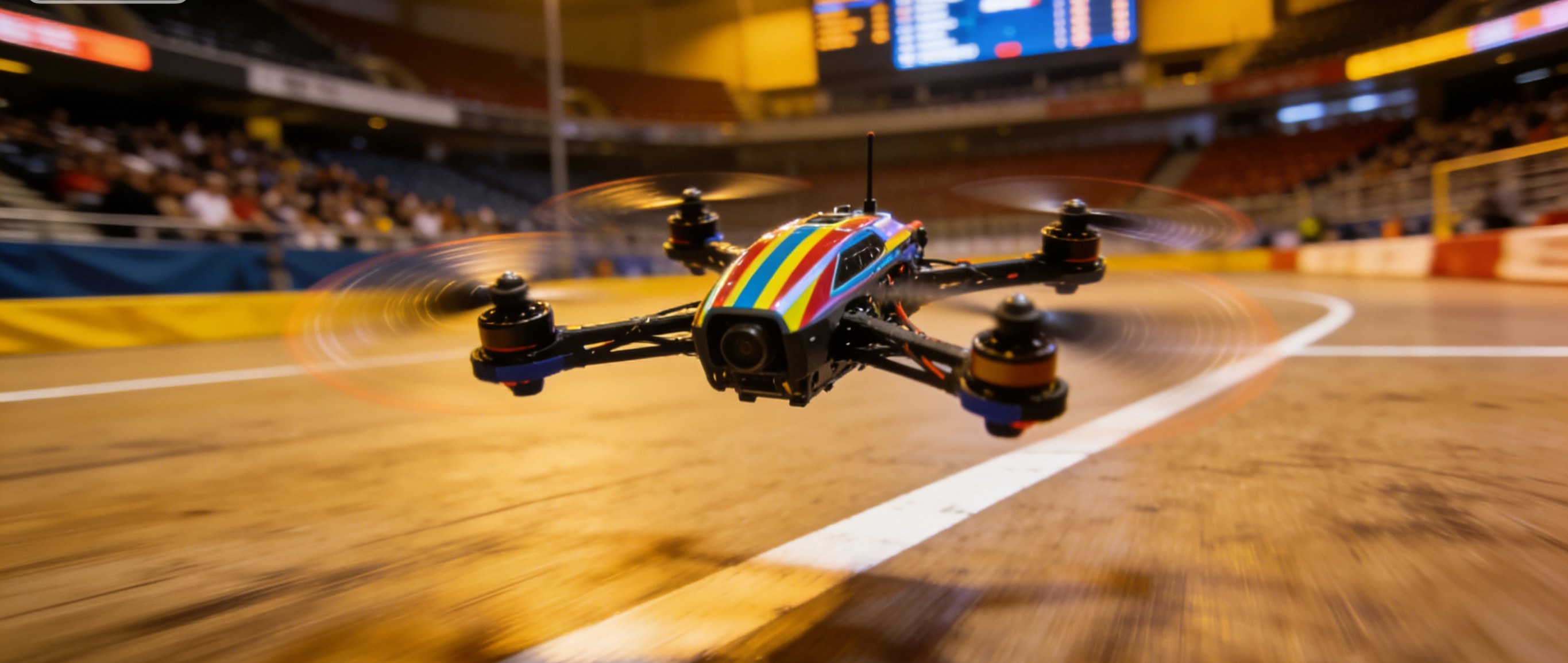
An FPV motor is the core component that transforms electrical energy into mechanical thrust, enabling FPV drones to achieve high-speed flight, rapid maneuvering, and precise control.
At first glance, it may look like a small spinning part attached to a propeller.
In reality, it is the heart of the entire UAV propulsion system.
Without a high-performance FPV drone motor, even the most advanced flight controller or aerodynamic frame cannot deliver stable or responsive flight performance.
Simply put:
No motor, no flight. Without a high-performance motor, there is no flight excellence
An FPV motor is typically a brushless DC motor (BLDC motor) designed specifically for high dynamic response and high power-to-weight ratio applications.
Unlike traditional brushed motors, a brushless FPV motor operates through electronic commutation, where the ESC (Electronic Speed Controller) controls the switching of current through the motor windings to generate a rotating magnetic field.
This interaction between:
Stator (stationary coils)
Rotor (rotating magnet assembly)
creates torque. And torque spins the propeller.
Think of an FPV motor as a magnetic engine.
Instead of fuel combustion, it uses electromagnetic forces to create motion.
Instead of pistons, it uses rotating magnetic fields.
Clean. Efficient. Extremely fast.
To truly understand an FPV motor, we need to break it down into its core components.
The stator consists of copper windings wrapped around laminated steel cores.
It is responsible for:
Generating magnetic fields
Converting electrical energy into electromagnetic force
The larger the stator volume, the higher the torque potential.
The rotor is the outer rotating part (in most FPV motors, known as an outrunner motor design).
It contains permanent magnets, usually high-grade neodymium magnets.
Its job is simple:
Follow the magnetic field
Spin at high speed
Bearings allow the rotor to spin smoothly with minimal friction.
High-quality bearings ensure:
Lower noise
Higher efficiency
Longer lifespan
These provide structural support and maintain alignment.
Even small deviations can cause:
Vibration
Efficiency loss
Mechanical wear
In operation, the ESC sends electrical signals to the motor windings in a precise sequence.
This creates a rotating magnetic field.
The rotor follows.
The propeller spins.
It sounds simple. But the reality is much more complex.
When a pilot pushes the throttle:
Current increases instantly
Magnetic field strength rises
Torque output spikes
RPM accelerates rapidly
All of this happens in milliseconds.
And it happens continuously.
An FPV motor does not operate at a constant speed.
It is always changing.
Always adjusting.
Always reacting.
One of the most important specifications of an FPV motor is its KV rating.
KV stands for:
RPM per volt (no-load condition)
A 2300KV motor powered by a 4S battery (~16V) can theoretically reach:
2300 × 16 = 36,800 RPM
High KV motors
Faster RPM
More aggressive response
Ideal for racing drones
Low KV motors
Higher torque
Better efficiency
Suitable for long-range or cinematic drones
High KV = sports car (fast acceleration)
Low KV = truck (strong pulling power)
Most FPV motors are outrunner motors, meaning the outer shell rotates instead of the inner shaft.
This design offers:
Higher torque output
Better propeller compatibility
Improved cooling through airflow
FPV drones need:
Instant acceleration
High thrust at low weight
Outrunner motors deliver exactly that.
Several factors determine how well an FPV motor performs:
Higher ratio = better acceleration and agility
Higher efficiency means:
Less heat
Longer flight time
More stable output
Heat is the enemy.
If a motor overheats:
Efficiency drops
Magnets may demagnetize
Lifespan decreases
Fast response = better control
Especially critical for:
FPV racing
Freestyle flying
AI-controlled drones
FPV motors are usually categorized by stator size:
22xx series (e.g., 2207, 2206)
→ Most common for 5-inch FPV drones
28xx series
→ Higher power, used for larger drones
14xx / 18xx series
→ Lightweight setups
Each size balances:
Torque
RPM
Efficiency
An FPV motor does not work alone.
It is part of a larger UAV propulsion system, including:
ESC
Battery
Propeller
Flight controller
Battery provides energy
ESC controls current
Motor generates torque
Propeller produces thrust
Remove one, and the system fails.
You can upgrade:
Frame
Camera
Software
But if your FPV motor is weak or inefficient, your drone will never reach its full potential.
An FPV motor is small.
But it decides:
How fast you fly
How smooth you control
How long you stay in the air
Understanding what an FPV motor is goes far beyond identifying a rotating component—it involves recognizing its role as the core driver of performance, efficiency, and control in modern FPV drones.
As drone technology continues to evolve, the brushless FPV motor will remain at the center of innovation, pushing the boundaries of speed, responsiveness, and intelligent flight systems.
In simple terms:
A great FPV drone starts with a great FPV motor.
 what's app