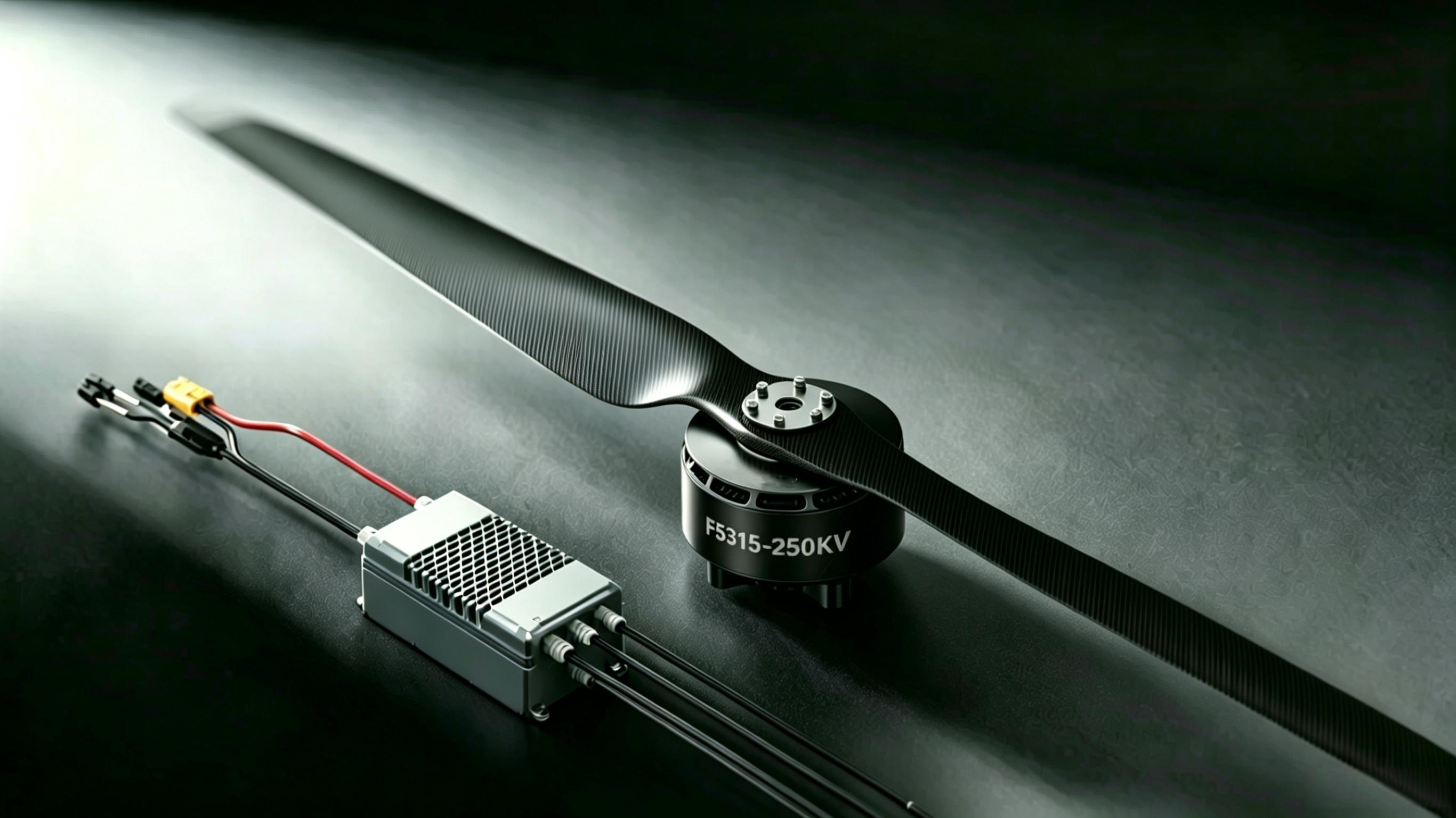
As UAV technology continues to evolve, payloads are becoming heavier, missions are becoming longer, and reliability has become more critical than ever before. A drone designed for power line inspection, LiDAR mapping, emergency response, or industrial logistics can no longer rely on propulsion systems originally developed for recreational aircraft.
This is precisely why the 5315 brushless motor has rapidly become one of the most sought-after propulsion solutions in the professional UAV market.
Rather than simply producing more thrust, the 5315 motor fundamentally changes how a 15-inch drone performs. Its larger stator generates substantially higher electromagnetic torque, allowing large propellers to rotate efficiently at lower RPM. The result is not only greater lifting capability, but also smoother flight characteristics, lower operating temperatures, reduced vibration, and significantly improved energy efficiency.
For UAV manufacturers, this means one thing:
More payload. Longer endurance. Greater reliability.
Instead of forcing a smaller motor to operate continuously near its maximum output, the 5315 motor provides abundant torque reserves. Hovering at only 45–55% throttle leaves sufficient power for rapid climbing, strong wind resistance, emergency maneuvers, and safe payload recovery, while dramatically reducing thermal stress on both the motor and the ESC.
For professional drone platforms expected to fly hundreds of hours every year, this reserve capacity directly translates into longer service life and lower maintenance costs.
The outstanding performance of the 5315 motor is not simply a result of its larger dimensions. It is the product of several engineering improvements working together to maximize propulsion efficiency.
The 53 mm stator diameter provides a significantly larger magnetic circuit, allowing stronger magnetic flux to interact with the windings. Combined with a 15 mm stator height, the motor produces substantially higher torque than smaller UAV motors without requiring excessive rotational speed.
This high-torque characteristic enables the motor to drive 15 to 18-inch carbon fiber propellers efficiently, generating powerful thrust while minimizing current consumption.
Compared with conventional UAV motors, the larger thermal mass also improves heat dissipation. During long-duration flights, the motor maintains lower operating temperatures, preserving magnet strength, protecting winding insulation, and extending bearing life.
These characteristics make the 5315 particularly attractive for commercial UAVs that operate continuously under demanding environmental conditions
Although different manufacturers offer customized winding configurations, most industrial-grade 5315 brushless motors fall within the following performance range.
| 5315 Drone Motor Basic Data | |
|---|---|
| Motor Size:5315 | KV Rating:260–400 KV |
| Stator Diameter:53 mm | Peak Current:80–100 A |
| Stator Height:15 mm | Continuous Output Power:2,000–2,500 W |
| Operating Voltage:6S–12S LiPo | Peak Output Power:Up to 3,200 W |
| Weight:430–550 g | Recommended Propeller:15–18 inch Carbon Fiber |
These specifications position the 5315 motor squarely between compact inspection drones and heavy-lift UAV platforms, making it one of the most versatile propulsion options available today.
Static thrust is often the first performance figure engineers examine, but maximum thrust alone never tells the whole story. More important is how efficiently that thrust is produced.
When paired with a high-voltage battery and optimized carbon fiber propellers, a 5315 motor delivers impressive lifting capability while maintaining excellent electrical efficiency.
| Battery | Propeller | Maximum Static Thrust |
| 6S | 15×5.5 | 4.8–5.2 kg |
| 8S | 15×5.5 | 5.8–6.5 kg |
| 12S | 15×5.5 | 7.0–7.8 kg |
| 12S | 16×5.4 | 7.8–8.6 kg |
| 12S | 17×5.8 | 8.8–9.5 kg |
For a quadcopter equipped with four 5315 motors, the available propulsion system can generate 28–38 kg of total static thrust, while an X8 platform can exceed 55 kg depending on the propeller and battery configuration.
These figures provide ample thrust reserve for industrial drones carrying high-value payloads such as LiDAR scanners, thermal imaging cameras, multispectral sensors, or logistics cargo.
One of the most common misconceptions in UAV propulsion design is assuming that all 5315 brushless motors deliver identical performance. In reality, the KV rating is one of the most influential factors affecting thrust, efficiency, flight endurance, and overall aircraft behavior.
Although the stator size remains unchanged, selecting a different KV rating fundamentally changes how the motor interacts with the propeller and battery system. Understanding these differences is essential for optimizing a 15-inch UAV for its intended mission.
The 280 KV version is optimized for high-voltage power systems and applications where endurance is more important than aggressive acceleration. Its lower rotational speed allows the motor to generate exceptionally high torque, making it ideal for driving 16 to 18-inch carbon fiber propellers while maintaining excellent efficiency.
Because the motor operates at lower RPM, current consumption is reduced and heat generation remains low, enabling longer continuous flight times and greater reliability during extended missions.
Typical applications include:
LiDAR mapping UAVs
Long-range inspection drones
Power transmission line inspection
Pipeline monitoring
Wind turbine inspection
Medium logistics UAVs
Professional aerial surveying
Typical Performance
| 5315 Drone Motor-280KV | |
|---|---|
| KV Rating:280 KV | Recommended Battery:12S LiPo |
| Continuous Power:2,000–2,600 W | Recommended Propeller:16×5.4 – 18×6.1 |
| Maximum Static Thrust:8.5–9.8 kg | Hover Efficiency:Excellent |
| Flight Endurance:★★★★★ | |
For aircraft expected to remain airborne for 40–60 minutes, the 280 KV configuration is often the most efficient choice.
The 320 KV motor offers an excellent compromise between lifting capability and efficiency. Compared with the 280 KV version, it provides slightly faster throttle response while still maintaining impressive endurance.
This configuration is widely used for mapping platforms, inspection drones, and industrial UAVs carrying cameras, thermal imaging systems, or multispectral sensors.
Typical Performance
| 5315 Drone Motor-320KV | |
| Recommended Battery:12S LiPo | Recommended Propeller:15×5.5 – 17×5.8 |
| Flight Efficiency:Excellent | Maximum Static Thrust:7.8–8.8 kg |
| Dynamic Response:High | |
Among all available winding options, 340 KV is often considered the most versatile.
It combines strong thrust, responsive throttle characteristics, and excellent cruising efficiency, making it suitable for the majority of professional UAV applications.
Typical applications include:
Industrial inspection
Emergency response
Professional aerial photography
Utility inspection
Medium-payload logistics
Search and rescue
Typical Performance
| 5315 Drone Motor-340KV | |
| Recommended Battery:12S LiPo | Recommended Propeller:15×5.5 – 16×5.4 |
| Maximum Static Thrust:7.2–8.2 kg | Flight Efficiency:Very High |
| Maneuverability:Excellent | |
The 400 KV configuration prioritizes acceleration and throttle response over maximum endurance.
Its higher rotational speed enables rapid climb performance and aggressive maneuvering, making it suitable for specialized industrial UAVs requiring fast dynamic response.
Typical Performance
| 5315 Drone Motor-400KV | |
| Recommended Battery:8S–12S LiPo | Recommended Propeller:15×5.5 |
| Maximum Static Thrust:6.5–7.5 kg | Dynamic Response:Outstanding |
| Endurance:Moderate | |
Although the 400 KV motor produces excellent acceleration, it typically consumes more current and operates at higher temperatures than lower-KV versions. For long-duration industrial missions, the 280 KV, 320 KV, or 340 KV configurations usually provide a better balance between performance and efficiency.
| Specification | 280 KV | 320 KV | 340 KV | 400 KV |
| Recommended Battery | 12S | 12S | 12S | 8S–12S |
| Recommended Propeller | 16–18" | 15–17" | 15–16" | 15" |
| Peak Static Thrust | 8.5–9.8 kg | 7.8–8.8 kg | 7.2–8.2 kg | 6.5–7.5 kg |
| Hover Efficiency | ★★★★★ | ★★★★★ | ★★★★☆ | ★★★☆☆ |
| Dynamic Response | ★★★☆☆ | ★★★★☆ | ★★★★★ | ★★★★★ |
| Endurance | ★★★★★ | ★★★★★ | ★★★★☆ | ★★★☆☆ |
| Payload Capability | ★★★★★ | ★★★★★ | ★★★★☆ | ★★★☆☆ |
From an engineering perspective, the 280 KV version delivers the highest torque reserve and best overall efficiency, making it particularly suitable for heavy-payload UAVs and long-endurance industrial platforms. The 320 KV and 340 KV versions provide the best balance for general-purpose commercial drones, while the 400 KV version is better suited to applications requiring rapid throttle response and high maneuverability.
When selecting a 5315 brushless motor, engineers should evaluate more than just the published thrust figures. Factors such as magnetic circuit design, winding quality, rotor balancing, bearing selection, thermal management, and manufacturing consistency all have a direct impact on flight performance and long-term reliability.
For OEM manufacturers and UAV developers, choosing a supplier that offers multiple KV options, custom winding configurations, and application-specific engineering support is often more valuable than selecting a standard off-the-shelf motor.
If you are developing professional UAV propulsion systems for inspection, mapping, logistics, emergency response, or heavy-payload aerial platforms, you can explore industrial-grade 5315 brushless motors and customized propulsion solutions at BGS Motor:
The website provides a range of UAV motors optimized for different battery voltages, propeller sizes, and mission profiles, along with OEM and customization services for aircraft manufacturers seeking high-efficiency, high-reliability propulsion systems.
 what's app