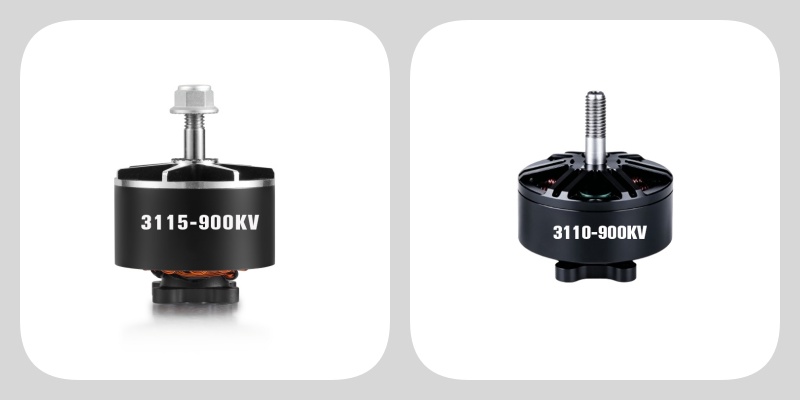
A more powerful drone motor sounds like an easy upgrade: more thrust, heavier payloads, and better flight performance. But what if the drone consumes more battery power, runs hotter, and still fails to deliver the expected flight time?
This is a common challenge in drone propulsion design. Motor power defines what a motor can potentially deliver, but efficiency and system compatibility determine how well it performs in real flight. A motor that looks impressive on a specification sheet may be a poor choice when paired with the wrong propeller, battery, or flight mission.
A powerful motor cannot compensate for a poorly matched propeller. Propeller diameter and pitch determine the aerodynamic load, while motor KV and battery voltage influence rotational speed. If these parameters do not work together, current consumption can rise without producing a proportional increase in useful thrust.
For example, a setup optimized for rapid FPV acceleration may not be the most efficient configuration for a drone designed to hover with a payload. The goal is not simply to spin the propeller faster, but to generate the required thrust at an appropriate power level.
A high-power motor is capable of delivering greater output, but it may consume more energy when operating outside its efficient range. For mapping, inspection, and agricultural drones, even a modest increase in average power consumption can reduce mission duration.
Instead of comparing maximum wattage alone, engineers should evaluate thrust per watt at the actual operating point. The most suitable motor is often the one that meets the aircraft's thrust requirements with less electrical power, not necessarily the one with the highest rated power.
High current creates additional heat, and winding copper losses increase approximately with the square of current when resistance is treated as constant. A motor that delivers impressive peak thrust for a few seconds may struggle to maintain the same output during a long flight.
This distinction matters for industrial and agricultural drones, where sustained performance is often more important than short bursts of maximum power. Thermal performance should therefore be assessed under realistic loads, airflow conditions, and operating durations.
Upgrading the motor without checking the rest of the electrical system can create a new set of problems. If the battery cannot supply the required current, voltage sag may reduce available output. An undersized ESC or unsuitable wiring can also introduce excess heat and limit reliable operation.
A propulsion system is only as capable as its supporting components. Motor, ESC, battery, and wiring specifications must be evaluated together rather than selected independently.
Different drones need different kinds of performance. FPV drones often prioritize fast throttle response and high thrust-to-weight ratio, while fixed-wing and industrial UAVs may place greater emphasis on cruise efficiency, payload capacity, and continuous operation.
A motor designed for short bursts of high output is not automatically the best choice for long-duration hovering. Before choosing a motor, engineers should define the aircraft's weight, payload, propeller configuration, target flight time, and typical operating conditions.
When comparing drone motors, five parameters provide a more useful picture of real-world performance.
| Parameter | What to Check |
|---|---|
| Thrust per Watt | How much thrust is produced for the electrical power consumed? |
| Current Draw | Can the battery and ESC support the load safely? |
| Temperature Rise | Can the motor sustain the required output without overheating? |
| Propeller Compatibility | Are the motor KV, voltage, and propeller load properly matched? |
| Continuous Output | Can the motor maintain performance throughout the mission, not just during a brief test? |
These figures should be compared under consistent test conditions, including the same propeller and voltage. Otherwise, a motor may appear more efficient simply because it was tested under a different load.
One important point: maximum thrust is not the same as maximum efficiency. A drone may need substantial thrust for takeoff and climbing, but spend most of its mission cruising or hovering at a much lower power level. Choosing a motor around the actual operating range can therefore matter more than optimizing for peak output alone.
Before choosing a higher-power motor, engineers should work through four questions:
How much thrust is actually required? Calculate the aircraft's takeoff weight, payload, and thrust demand per motor, allowing sufficient reserve for climbing and maneuvering.
Which propeller matches the motor? Compare thrust, current, and power consumption using test data for the intended propeller and battery voltage.
Can the system handle the load? Check the battery's discharge capability, ESC current rating, wiring, and cooling conditions.
Will it perform over the full mission? Evaluate sustained temperature, current draw, and efficiency—not only short-duration maximum thrust.
This approach helps prevent oversized motor selection and keeps the focus on useful performance rather than impressive-looking specifications.
For FPV drones, motor selection often involves balancing responsiveness, thrust, weight, and propeller compatibility. For agricultural, mapping, and industrial UAVs, continuous output, thermal behavior, and energy efficiency may be equally important.
BGS Motor offers outer-rotor brushless motors for different drone propulsion applications. The right model should be selected according to the aircraft configuration and mission requirements rather than power rating alone.
Explore the BGS Motor FPV Motor Range to review available options. For a more targeted recommendation, provide your aircraft weight, payload, propeller size, battery voltage, and target flight time.
A high-power motor can still deliver poor flight performance when the propeller is mismatched, energy consumption is excessive, cooling is inadequate, or the electrical system cannot support the load.
The better approach is to evaluate the complete propulsion system under realistic conditions. By comparing thrust, power consumption, current, temperature rise, and continuous output, engineers can identify a motor that meets the mission requirements without sacrificing efficiency or reliability.
The best drone motor is not necessarily the most powerful one. It is the one that delivers the right thrust, at the right efficiency, for the entire mission.
 what's app