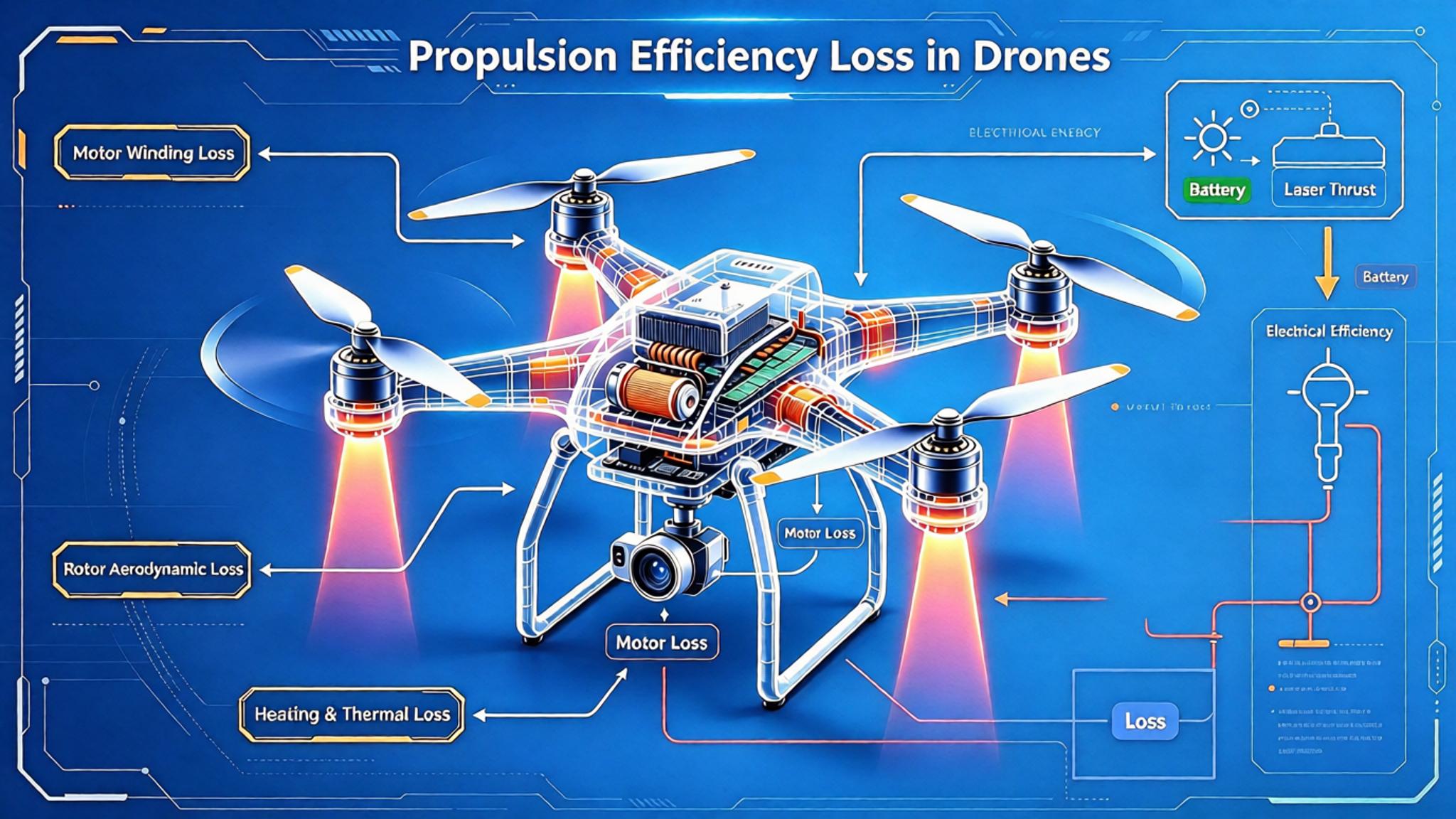
Your drone battery is fully charged, the motor specifications look impressive, and the propeller is spinning at high speed. So why is flight time still shorter than expected?
The answer may lie in the hidden losses throughout the propulsion system. From motor windings and ESC switching to propeller aerodynamics and heat dissipation, not all electrical energy is converted into useful thrust. Small inefficiencies can accumulate, consuming valuable battery power without helping your drone fly farther or carry more payload.
Let's uncover six common sources of energy loss—and explore how to reduce them.
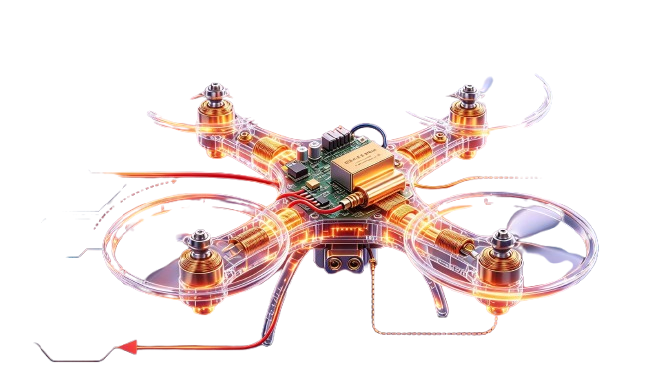
Every motor winding has electrical resistance. As current flows through the windings, some energy becomes heat instead of mechanical output. The catch? Copper loss increases with the square of current, meaning a 20% increase in current can produce approximately 44% more copper loss if resistance remains constant.
How to reduce it:
Match motor KV, battery voltage, and propeller load.
Avoid excessive current demand during normal operation.
Choose a motor with suitable winding and thermal capacity.
Inside a brushless motor, magnetic fields change continuously as the rotor spins. This creates hysteresis and eddy-current losses in the magnetic core. Higher operating speeds can increase these losses, depending on the motor's magnetic design and operating conditions.
How to reduce it:
Select a motor designed for your required speed range.
Consider magnetic materials and core design.
Choose KV based on the complete propulsion system, not RPM alone.
The ESC controls how electrical power reaches the motor, but power conversion is never completely loss-free. Semiconductor conduction and switching generate heat, while undersized wiring and poor connections add further losses.
How to reduce it:
Match ESC voltage and current ratings to the propulsion system.
Provide sufficient continuous-current capacity and cooling.
Use suitable wiring and reliable electrical connections.
A powerful motor cannot compensate for a poorly matched propeller. Too much diameter or pitch can overload the motor, while an undersized propeller may require excessive RPM to generate the required thrust. In both cases, the battery may be working harder than necessary.
How to reduce it:
Match propeller diameter and pitch to motor KV and battery voltage.
Compare thrust per watt under consistent test conditions.
Check propeller balance, blade condition, and the intended flight profile.
Remember: the best propeller is not necessarily the one that produces the highest peak thrust, but the one that delivers the required thrust efficiently.
An unbalanced propeller, worn bearing, or poorly secured motor mount may seem like a minor issue. However, vibration and mechanical stress can reduce reliability, accelerate wear, and interfere with stable flight control.
How to reduce it:
Balance propellers and rotating components.
Check motor alignment and mounting rigidity.
Inspect bearings, shafts, and fasteners regularly.
When electrical losses accumulate, motor and ESC temperatures rise. Hotter copper has higher resistance, which can further increase copper loss at the same current. If cooling cannot keep up, the system may struggle to sustain its required output.
How to reduce it:
Design around continuous power, not just peak power.
Improve airflow and heat transfer where possible.
Monitor motor and ESC temperatures during sustained-load tests.
A motor that delivers impressive power for a few seconds is not necessarily the right choice for a drone that must work for an hour.
A drone's battery is a limited energy budget, and every unnecessary loss takes a little more flight time away. Copper loss, magnetic core loss, ESC inefficiency, propeller mismatch, mechanical vibration, and excessive heat are connected parts of the same problem.
The solution is not simply to install a larger motor or a higher-rated ESC. It is to optimize the entire propulsion system around the drone's actual mission.
At BOGONG SUN (BGS MOTOR), selecting the right outer-rotor brushless motor starts with understanding the application, required thrust, propeller dimensions, operating voltage, and thermal conditions. Because better propulsion performance is not just about making more power—it's about wasting less of it.
 what's app