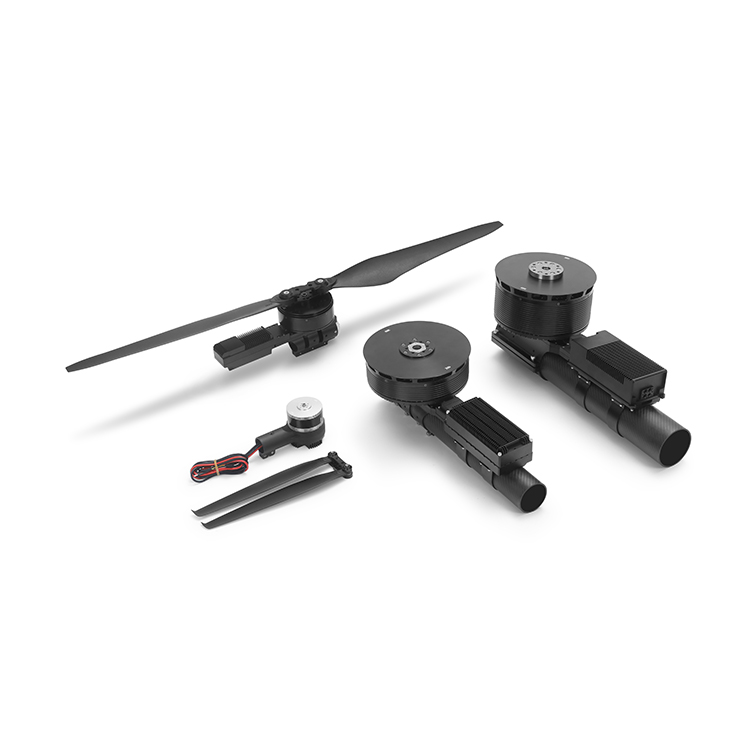
KV describes a brushless motor’s no-load RPM per volt. Low KV means lower RPM per volt; high KV means higher RPM per volt.
Low-KV drone motors are widely used in industrial and commercial UAVs because they can work with larger propellers and higher-voltage systems, supporting high torque, stable thrust, payload lifting, and efficient long-duration flight.
From agricultural spraying and logistics to surveying, inspection, mapping, and heavy-lift UAVs, low-KV motors power demanding applications where stable thrust, payload capacity, and endurance matter.
 KV is an important parameter for a brushless motor, especially when you select a brushless drone motor for a UAV propulsion system. It normally means the motor's no-load rotational speed per volt, expressed as RPM/V. For example, a 400KV motor theoretically rotates at about 400 RPM for every volt applied without a propeller load. Therefore, at the same voltage, a lower-KV motor rotates more slowly than a higher-KV motor.
However, KV does not directly represent motor power, thrust, or quality. Actual motor performance also depends on motor size, winding design, magnetic structure, voltage, current, propeller diameter and pitch, ESC, cooling, and operating conditions.
The relationship between KV and torque is also important. A lower-KV winding is generally suited to producing the torque required to turn a larger propeller at a lower RPM. A larger propeller can move more air, but it also creates greater load on the motor. Therefore, the motor, propeller, battery, and ESC must be selected as one propulsion system rather than according to KV alone.
For example, a low-KV motor may be paired with a large propeller and higher-voltage battery, while a high-KV motor is more commonly paired with a smaller propeller. The correct combination depends on the drone's weight, required thrust, payload, flight time, and operating conditions.
The main advantage of a Low KV drone motor is that it can provide the operating characteristics required by larger-propeller UAV propulsion systems. Instead of simply pursuing extremely high RPM, a low-KV UAV motor is normally selected when the drone needs stable thrust, higher torque capability, and efficient operation under a propeller load.
First, low-KV motors are suitable for larger propellers. Larger propellers can generate strong lift at relatively lower rotational speeds, making this combination useful for heavy-lift and endurance-oriented UAVs. Current commercial motor products show low-KV configurations being matched with large propellers and higher-voltage battery systems for agricultural, surveying, inspection, logistics, and other industrial platforms.
Second, low-KV systems can support higher-voltage power systems. Because motor speed depends on both KV and voltage, you can use a lower KV with a higher battery voltage to reach the required operating speed. This can be useful when designing a high-power propulsion system, although the complete electrical system must still be checked for current, voltage, thermal, and ESC limits.
Third, low-KV drone motors are well suited to stable payload operation. Industrial UAVs may carry cameras, LiDAR, agricultural spraying equipment, inspection sensors, or delivery payloads. These applications place greater demands on continuous thrust and propulsion stability than lightweight recreational drones.
Low-KV drone electric motors are currently used in many professional UAV applications where payload, endurance, and stable propulsion are important.
1.Agricultural drones are one important application. Spraying UAVs may need to carry liquid, pumps, tanks, and other equipment. A suitable low-KV brushless motor can drive a larger propeller and provide the thrust needed for the aircraft and its payload. Commercial motor suppliers currently list low-KV configurations for agricultural spraying and heavy-lift applications.
2.Logistics and delivery UAVs also require propulsion systems capable of carrying useful payloads while maintaining stable flight. Low-KV configurations are commonly associated with larger multirotor platforms designed for payload-focused missions.
3.For industrial surveying and mapping, the drone may carry cameras, LiDAR, multispectral sensors, or other measurement equipment. Stable thrust and endurance are important because the UAV may need to maintain a predictable flight path for an extended period. Current industrial motor offerings identify surveying, mapping, inspection, and aerial photography as applications for lower-KV propulsion systems.
Other applications include infrastructure inspection, aerial photography, security, research platforms, and large multirotor aircraft. The exact KV value should always be selected according to the complete propulsion design rather than the application name alone.
There is no single low-KV motor that is suitable for every UAV. You should first define the drone's total takeoff weight, payload, number of motors, target propeller size, battery voltage, required hover thrust, maximum thrust, flight time, and operating environment.
For example, current commercial motor catalogs include configurations such as approximately 260–420KV motors for large-propeller and heavy-lift UAV applications, while other professional UAV motors are offered around 350–600KV for medium-to-large propulsion systems. Some heavy industrial motors are available at approximately 80–100KV for very large propellers and high-voltage systems.
These numbers should be treated as examples, not universal standards. A 400KV motor on a high-voltage battery can have a different operating speed from a 400KV motor on a lower-voltage battery. Propeller size also changes the motor load substantially.
When selecting a brushless drone motor, check these parameters together:
Motor KV: Match the required RPM and propeller.
Motor size: A larger stator generally provides greater torque and power capability.
Propeller: Check diameter and pitch against the motor manufacturer's test data.
Battery voltage: Ensure the motor is designed for the selected battery system.
ESC: Check continuous and peak current, voltage rating, and compatibility.
Thrust: Calculate the total required thrust based on aircraft weight and payload.
Thermal performance: Check whether the motor can operate continuously without excessive temperature.
Mechanical dimensions: Confirm shaft, mounting holes, motor diameter, and installation space.
BG Motor's documented brushless DC motor customization range covers 5W–20KW, DC6V–310V, 20–100,000 RPM, and 28–258 mm diameter, with customized shafts, mounting holes, protection levels, and installation arrangements. The company can also integrate brushless motors with drives, encoders, brakes, and gearboxes.
For UAV manufacturers, this means the motor can be considered as part of a customized propulsion solution rather than as an isolated component.
The most common mistake is choosing a motor based only on its KV number. KV indicates the no-load RPM-per-volt relationship; it does not tell you the complete thrust, efficiency, torque output, or maximum payload capability.
Another common problem is an incorrect motor-propeller combination. A large propeller creates more load, so the motor must be capable of handling that load at the required operating point. An unsuitable combination can increase current consumption and heat and may reduce system reliability.
You should also avoid selecting the ESC or battery separately from the motor. A reliable UAV propulsion system requires compatibility among the motor, propeller, ESC, battery, and flight controller.
For industrial applications, environmental conditions should also be considered. BG Motor states that its customized brushless DC motors can achieve protection levels up to IP68 depending on requirements, while its overall services include customized motor dimensions, test reports, performance curves, and integrated drive, brake, encoder, reducer, and connector solutions.
In short, selecting a low-KV UAV motor is a system-engineering task. You should evaluate the complete propulsion chain and actual mission requirements instead of selecting the lowest or highest KV available.
Choosing a Low KV drone motor is not simply about selecting a lower KV value. The right UAV motor must be matched with your propeller, battery voltage, ESC, aircraft weight, payload, and required flight time. For agricultural spraying, logistics, industrial surveying, inspection, and heavy-lift UAVs, a properly designed brushless motor system can provide the torque, stable thrust, efficiency, and reliability needed for demanding operations. BG Motor supports customized brushless drone motor solutions based on your specific power, size, speed, shaft, mounting, and protection requirements, helping you build a propulsion system that fits your UAV application.
 what's app