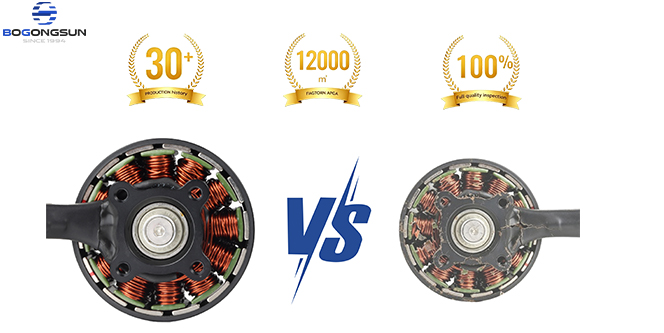
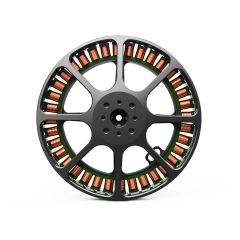
In UAV propulsion systems, maximum motor power does not necessarily determine how much power a motor can deliver in real flight. For industrial drones, agricultural spraying UAVs, heavy-lift platforms and long-duration multirotors, the motor may need to operate under high load for minutes or even hours, making temperature control one of the key factors limiting continuous output. Electrical losses in the windings, magnetic losses in the stator and mechanical losses in the bearings are continuously converted into heat; if this heat cannot be transferred and dissipated effectively, winding temperature rises, efficiency decreases and the motor may gradually lose its ability to maintain stable thrust. Therefore, a high-performance UAV motor should not only deliver high peak thrust, but also maintain a controlled operating temperature so that its output remains stable throughout the mission.
When a motor drives a large propeller or operates at high throttle for an extended period, the electrical current through the windings increases, producing copper losses that are converted directly into heat. At the same time, the magnetic circuit generates additional losses, while bearings and other rotating components contribute mechanical losses. The relationship between load and temperature is particularly important because copper loss increases approximately with the square of current, meaning that even a moderate increase in current can create a much larger increase in winding heat.
For this reason, motor temperature is not simply a result of the motor's rated power; it is strongly influenced by the complete propulsion system, including motor KV, propeller size, battery voltage, ESC settings and aircraft load. An incorrectly matched propeller can force the motor to draw excessive current, increasing heat generation even when the motor itself has been properly designed.
Effective thermal management works by shortening the path between heat generation and heat dissipation. In a brushless outrunner motor, heat generated by the copper windings must first transfer through the stator structure and then reach the surrounding housing before being released into the airflow. Optimized stator geometry, high thermal-conductivity structures and an appropriate external rotor design can improve this heat-transfer process, while airflow around the rotating motor helps carry heat away from the motor surface.
This is particularly valuable for UAVs because the propulsion system naturally operates in a moving-air environment. A well-designed outrunner structure can take advantage of this airflow to improve cooling without requiring additional fans or complex active cooling systems. BGS multi-rotor motors, for example, use optimized airflow channels and high-thermal-conductivity structures to improve heat dissipation during continuous operation.
| Stage | Main Factor | Thermal Effect |
|---|---|---|
| Heat Generation | Current, winding resistance, magnetic losses | Determines how much heat is produced |
| Heat Transfer | Stator, housing and thermal materials | Moves heat away from the windings |
| Heat Dissipation | Rotor airflow and surrounding air | Releases heat into the environment |
| Temperature Control | Complete propulsion matching | Maintains stable continuous output |
The objective is therefore not simply to "make the motor cooler", but to establish an efficient thermal path from the winding to the surrounding air. Better thermal management allows the motor to remain closer to its optimal operating temperature, reducing thermal stress and helping preserve efficiency, magnetic performance and winding insulation during prolonged operation.
For UAV applications, thermal management cannot be considered independently from environmental protection. Agricultural drones, for example, may operate in humid environments and around water droplets, chemicals and dust, while industrial UAVs can be exposed to high temperatures and demanding outdoor conditions. A highly enclosed motor can improve protection against external contamination, but excessive enclosure may also restrict airflow and make it more difficult for internally generated heat to escape.
The best solution therefore balances protection, airflow and heat dissipation according to the mission environment. This is especially important for agricultural and industrial UAV motors, where continuous operation and environmental reliability are often more important than short-duration peak performance.
Thermal requirements change significantly according to the aircraft's flight profile. FPV drones may demand very high current during rapid acceleration and aggressive maneuvers, so fast heat dissipation is important for recovering between high-power bursts. Multirotor inspection and mapping platforms, in contrast, often spend long periods hovering with relatively stable loads, making continuous efficiency and temperature control more important. Agricultural and heavy-lift UAVs place an even greater thermal burden on the propulsion system because they must maintain high thrust while carrying payloads for extended periods.
| UAV Application | Typical Thermal Challenge | Main Design Priority |
|---|---|---|
| FPV | High current during acceleration | Rapid heat dissipation and low weight |
| Multirotor | Long-duration hovering | Stable temperature and continuous efficiency |
| Agricultural UAV | High payload and extended operation | Thermal stability and environmental protection |
| Industrial UAV | Continuous high-load missions | Reliability and sustained output |
| Heavy-Lift UAV | High torque and large propellers | Heat transfer and continuous power |
This is why there is no universal cooling structure that is ideal for every UAV. The thermal design must be developed around the motor's electrical characteristics, propeller load and intended flight profile.
Motor cooling begins with correct propulsion-system matching. A motor operating with an oversized or overly aggressive propeller may require significantly more torque, causing current to rise and generating additional heat inside the windings. In contrast, a correctly matched propeller allows the motor to operate closer to its efficient working range, reducing unnecessary electrical losses while maintaining the required thrust.
This is particularly important for large industrial and long-endurance UAVs, where the goal is not simply to achieve the highest possible static thrust but to maintain the required thrust efficiently over a long period. BGS's UAV motor selection approach therefore considers motor size, KV, propeller configuration, battery voltage and application requirements together rather than treating the motor as an isolated component.
 For professional UAV manufacturers, the real value of a motor is not how much power it can produce for a few seconds on a test bench, but how reliably it can maintain useful output under actual flight conditions. A motor with optimized electromagnetic design, effective heat transfer, balanced rotor construction and suitable airflow can maintain more stable temperature and efficiency during prolonged operation, which ultimately contributes to longer motor life and more predictable aircraft performance.
BGS UAV motors incorporate optimized outrunner structures, thermal management systems, precision dynamic balancing and high-load components for applications ranging from aerial imaging and surveying to agricultural spraying and heavy-lift logistics. The company's motor portfolio covers FPV, multi-rotor, fixed-wing and vertical UAV platforms, allowing propulsion systems to be selected according to different requirements for thrust, efficiency and continuous operation.
Better thermal management → lower operating temperature → more stable efficiency → stronger continuous output → greater UAV reliability.
For UAV manufacturers developing a new propulsion system, motor selection should therefore consider not only peak thrust and power, but also propeller load, battery voltage, expected flight duration, operating environment and thermal performance. BGS provides UAV motor solutions and OEM/ODM customization for different propulsion requirements, helping manufacturers optimize motor configuration for continuous output, efficiency and mission-specific performance.
 what's app