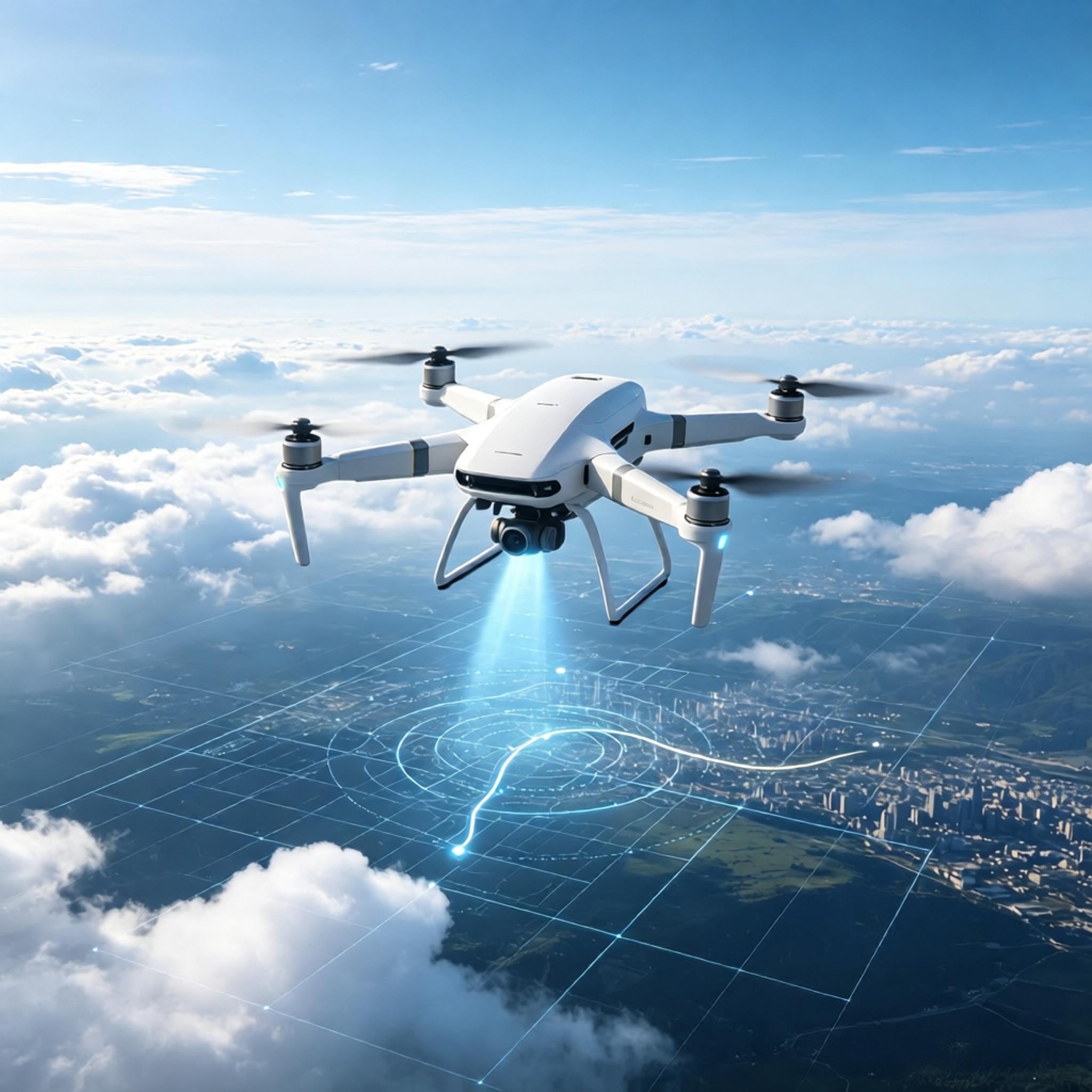
Artificial intelligence is not simply another software technology. It is becoming a fundamental driver of digital transformation across manufacturing, logistics, agriculture, inspection, healthcare, security, and many other industries. The important change is that AI is moving equipment from “being controlled by people” to “perceiving, analyzing, deciding, and acting with greater autonomy.”
This change is creating a new generation of intelligent equipment. A machine equipped with sensors can collect information, AI can process that information and make decisions, and mechanical components then execute those decisions. In other words, the value of AI does not stop at the algorithm. It must ultimately be converted into physical movement.
Drones are one of the clearest examples of this transformation.
A traditional drone is mainly a flight platform operated by a person. An AI-enabled drone is gradually becoming an intelligent mobile system that can perceive its surroundings, analyze data, plan its actions, and complete specific missions with less human intervention. As the role of the drone changes, the requirements for its hardware also change.
This is where the development of AI begins to create a direct impact on motors, drives, control systems, sensors, batteries, and the overall mechanical structure of drones. For drone manufacturers, the question is no longer only how to make a drone fly. The more important question is how to make it fly accurately, efficiently, reliably, and intelligently according to the mission requirements.
To understand the new requirements created by AI, it is first necessary to understand how drones are changing.
Traditional drones generally rely heavily on human operators. The operator controls the flight direction, altitude, speed, and mission process. The drone mainly performs the physical task according to external instructions.
This model is effective for many applications, but it has limitations. When the environment becomes complex or the number of drones increases, continuous human control becomes more difficult. A drone may need to process large amounts of visual, geographic, or sensor data while responding to changing conditions.
AI changes this relationship.
An AI-driven drone can combine cameras, positioning systems, sensors, onboard computing, communication systems, and control algorithms to create a more intelligent decision-making process.
The basic logic becomes:
Perception → Data Processing → Decision → Motion Control → Mission Execution
The drone first collects information from its environment. AI then analyzes the information and determines an appropriate action. The flight-control system converts that decision into commands, and the motors execute the commands through changes in speed and torque.
This creates an important engineering relationship:
AI determines what the drone should do, while the motor system determines how accurately and reliably the drone can do it.
Therefore, AI development does not only increase the requirements for software. It also raises the technical requirements for the physical components that execute AI decisions.
The development of AI is changing the drone ecosystem from an individual flying machine into a more integrated intelligent system.
A modern intelligent drone may include:
AI processors and computing units
Cameras and visual sensors
GPS and positioning systems
Radar or other environmental sensors
Flight controllers
Communication systems
Batteries and power management systems
Motors and electronic drives
Propellers and mechanical structures
These components are no longer independent.
For example, an AI system may identify an obstacle and decide that the drone needs to change direction quickly. The flight controller then needs to adjust the motor speed. The motor must respond quickly and accurately enough to produce the required change in thrust.
If the motor response is slow, unstable, or inconsistent, the quality of the AI decision cannot be fully converted into physical movement.
This means the development of intelligent drones requires closer cooperation between software, electronics, mechanical engineering, and motor technology.
For drone manufacturers, motor selection therefore needs to move beyond simple specifications such as rated voltage and rated speed. You need to consider the complete operating system, including drone weight, propeller size, required thrust, battery capacity, payload, flight time, operating environment, control strategy, and expected service life.
As drones become more intelligent, the motor becomes an increasingly important part of the overall system.
Drone systems are highly sensitive to weight. Every additional gram can affect battery consumption, payload capacity, and flight time.
The motor therefore needs to provide sufficient power and torque without adding unnecessary weight. This creates a demand for compact motors with a high power-to-weight ratio.
AI-driven drones may need to change speed or flight direction quickly.
The motor must therefore respond rapidly to changes in control commands. This requires suitable motor design, drive matching, and control characteristics.
The motor does not simply need to rotate. It needs to rotate at the required speed and maintain stable operation under changing loads.
Precise speed control is important for maintaining stable thrust and predictable flight behavior.
Vibration is particularly important for intelligent drones.
High vibration can influence cameras, sensors, positioning systems, mapping results, and overall flight stability. Therefore, motor balance, mechanical design, bearing selection, manufacturing accuracy, and system matching all become important.
Battery capacity is limited. A motor with poor efficiency can convert more electrical energy into heat instead of useful mechanical output.
Higher motor efficiency can help improve energy utilization and support longer operating time, although the final flight endurance also depends on the complete propulsion and battery system.
For industrial drones, frequent motor replacement is not practical. Drones used for inspection, agriculture, mapping, delivery, or security may need to operate repeatedly for long periods.
Motor reliability therefore becomes part of the reliability of the entire drone system.
The real value of AI is not simply that drones can become more autonomous. The greater opportunity is that AI allows drones to perform more complex tasks and process information more effectively.
AI can support route planning, location recognition, obstacle detection, and autonomous operation.
For delivery drones, the propulsion system must provide stable and predictable movement while also meeting requirements for payload capacity and energy efficiency.
Drones can collect large amounts of visual and geographic information. AI can help process images and identify terrain, buildings, infrastructure, and other features.
For these applications, stable flight and low vibration are particularly important because movement quality can affect the quality of collected data.
AI-enabled drones can monitor crops, identify areas requiring attention, and support precision agricultural operations.
Agricultural drones may also need to carry additional equipment or payloads. This increases the requirements for motor torque, power, efficiency, and continuous operation.
Drones can inspect power lines, industrial facilities, construction sites, pipelines, and other infrastructure.
AI can help identify abnormal conditions from collected images or sensor data. The drone therefore becomes not only an inspection platform but also a mobile data-collection and analysis system.
AI can support object recognition, environmental monitoring, and automated response.
For security applications, reliability is particularly important because the drone may need to operate continuously and respond quickly to changing conditions.
As logistics systems become more digitalized, drones may become part of a larger automated transportation network.
This creates requirements for reliable motors, precise control, stable operation, and compatibility with other automated equipment.
In all of these applications, there is a clear relationship:
AI increases the intelligence of the drone, while motor technology determines how effectively that intelligence can be translated into physical action.
The development of AI also changes the traditional product-development process.
In the past, a drone manufacturer could often select a motor after defining the basic mechanical structure. Today, this approach may not be sufficient for highly specialized intelligent drones.
The motor should be considered earlier in the design process.
For example, the required motor can be influenced by:
Mission requirements → Drone weight → Payload → Propeller → Required thrust → Battery → Motor → Drive and control system
Changing one part can affect the others.
If the payload increases, the required thrust may increase. If the required thrust increases, the motor may need higher torque or power. Higher power can influence motor size, heat generation, battery consumption, and flight time.
This is why motor customization can become valuable for specialized drone applications.
Instead of choosing a standard motor only from a catalog, manufacturers can work with a motor supplier to evaluate the complete application and develop a motor around the actual operating conditions.
AI-driven drones can provide several important advantages.
Higher automation: More flight and mission decisions can be completed with less continuous human intervention.
Higher operating efficiency: AI can optimize routes, analyze data, and reduce unnecessary operations.
Better precision: Intelligent perception and control can improve the accuracy of flight and task execution.
Broader applications: Drones can move beyond photography and basic remote control into agriculture, inspection, mapping, logistics, delivery, and other industrial applications.
Greater scalability: Intelligent systems can create new possibilities for managing multiple automated devices and integrating drones into digital production and logistics systems.
For motor manufacturers, this development creates another opportunity: the motor is becoming part of a complete intelligent solution rather than an isolated component.
AI does not remove engineering challenges. In many cases, it makes them more demanding.
Drones have limited internal space. AI processors, sensors, batteries, communication modules, and other equipment all compete for space and weight.
The motor therefore needs to achieve the required performance within strict dimensional limits.
Higher power density can increase heat generation. If heat is not managed properly, motor efficiency, service life, and system reliability may be affected.
Low noise and vibration are increasingly important when drones carry sensitive cameras and sensors.
The problem cannot always be solved by the motor alone. Motor design, propeller matching, mechanical structure, bearings, and control systems all need to be considered together.
The more autonomous the drone becomes, the more important system reliability becomes.
A motor failure can affect flight stability and may result in mission failure. Therefore, manufacturers need appropriate quality control, testing, protection, and system-level safety strategies.
As drones become connected intelligent devices, they also become part of digital networks. Data transmission, remote control, software updates, and AI systems all require appropriate security measures.
AI development therefore creates a dual requirement:
Drones need to become more intelligent, but they must also become more reliable and controllable.
The development of AI is changing the definition of a suitable drone motor.
A suitable motor is not necessarily the motor with the highest power or the highest speed. It is the motor that matches the specific application and complete drone system.
You need to consider:
Required thrust and torque
Motor weight and dimensions
Operating voltage
Speed range
Dynamic response
Efficiency
Noise and vibration
Thermal performance
Service life
Environmental conditions
Drive and control compatibility
Production consistency
This is where customized motor development can provide value.
BG Motor has an R&D team covering power, structural, and mechanical engineering, with engineers who have more than 20 years of motor-industry experience. The company uses electromagnetic simulation tools including ANSYS, JMAG, Motor-CAD, and EasiMotor during motor development.
For customized brushless DC motors, BG Motor supports power ranges from 5W to 20KW and rated speeds from 20 to 100,000 RPM. Motor dimensions, shaft specifications, mounting holes, installation methods, and other parameters can be customized according to application requirements. Protection levels can reach IP68 depending on the design requirements.
BG Motor can also integrate motors with drives, encoders, gearboxes, brakes, and other components. This integrated approach can help you evaluate the motor as part of the complete equipment rather than as an independent component.
The development of drones is entering a new stage.
The first stage was mainly about making drones fly.
The next stage is about making drones fly intelligently.
This difference is important. Once AI allows drones to perceive their environment, process information, make decisions, and perform increasingly autonomous tasks, the physical system must be able to respond with the same level of precision and reliability.
That is why AI is creating new requirements for drone motors.
The future drone motor will need to be more than a power source. It will need to work as part of an intelligent motion system, providing the required combination of power density, precise control, fast response, efficiency, low vibration, and long-term reliability.
For drone manufacturers, this means motor selection should begin with the application rather than the catalog.
The better question is not “Which motor can make my drone fly?” but “Which motor can help my drone complete its intelligent mission accurately, efficiently, and reliably?”
As AI and digital transformation continue to develop, the companies that can successfully connect AI algorithms, electronic control, mechanical design, and motor technology will have a stronger foundation for developing the next generation of intelligent drones.
 what's app