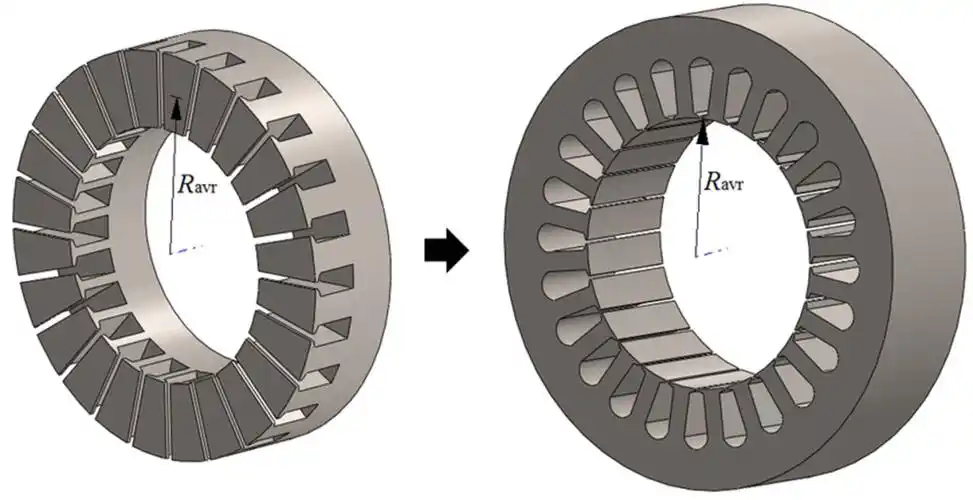
As multirotor drones develop toward heavier payloads and longer flight times, propulsion systems must balance torque, weight, efficiency, and installation space. Among the technologies attracting attention is the Axial Flux Motor, also known as a disc motor because of its flat structure. Unlike conventional radial flux motors, it generates magnetic flux parallel to the motor shaft, creating a compact design with potential advantages in torque density and power integration.
An axial flux motor uses a flat magnetic structure in which the rotor and stator interact across an air gap along the motor's axial direction. Its main components include a disc-shaped rotor with permanent magnets, a stator containing copper windings, and an axial air gap that enables electromagnetic energy conversion.
Common configurations include single-rotor and single-stator designs, dual-rotor structures with a stator in between, and single-rotor designs with two stators. Each arrangement offers different possibilities for balancing torque output, motor dimensions, weight, and manufacturing complexity.
High Torque Density: The disc-shaped electromagnetic structure provides a relatively large effective radius, allowing some axial flux designs to deliver high torque without requiring a long cylindrical housing. This can be useful for drone propulsion systems that need strong output within limited installation space.
Compact Axial Dimensions: Compared with conventional cylindrical motors, axial flux motors generally have a shorter axial length, creating more flexibility when arranging propulsion components, ESCs, and cooling structures on a drone.
Power Density and Efficiency Potential: Optimized magnetic circuits and shorter winding end turns can help reduce certain losses while improving power density. However, actual efficiency depends on winding design, magnetic materials, cooling, and the operating point rather than motor structure alone.
Dynamic Response: Some lightweight axial flux designs feature relatively low rotor inertia, which can support faster speed changes. This is valuable for multirotor flight control, although propeller inertia and ESC performance also influence the overall response.
Flexible Design: By adjusting rotor and stator configurations, engineers can develop different power and torque solutions for specialized UAV platforms, although manufacturing cost and thermal performance must be considered.
Heavy-Lift Drones: Heavy-lift platforms require sufficient thrust to carry the aircraft, payload, and onboard equipment. Axial flux motors may provide an attractive option where high torque density and compact installation are important, but continuous power and heat dissipation remain essential selection factors.
Agricultural Drones: Spraying and spreading drones operate with changing payload weights and often require extended working periods. A suitable propulsion system must maintain stable thrust while handling continuous loads, making torque output, cooling, and propeller matching particularly important.
Industrial and Logistics Drones: Cargo delivery and industrial UAVs place greater emphasis on payload capacity, endurance, and reliability. Axial flux designs offer another approach to compact propulsion integration, especially for aircraft with specific structural or installation constraints.
Although axial flux motors offer an alternative structure, radial flux outrunner motors remain widely used in multirotor propulsion because of their mature manufacturing processes and extensive application experience.
| Comparison | Axial Flux Motor | Radial Flux Outrunner |
|---|---|---|
| Structure | Flat disc-shaped | Cylindrical |
| Magnetic flux | Axial direction | Radial direction |
| Axial length | Generally shorter | Depends on design |
| Torque density | Potentially high | High in optimized designs |
| Integration | Low-profile installation | Mature drone mounting |
| Manufacturing | More specialized in some designs | Widely established |
| Applications | Specialized propulsion systems | FPV, agricultural and industrial UAVs |
Axial flux motors are worth considering when a drone requires a low-profile structure and specialized torque output, while radial flux outrunners remain a practical choice for many standard multirotor platforms due to their established performance, propeller compatibility, and production availability. Neither design is universally superior; the decision should reflect the aircraft's actual operating requirements.
Selecting a motor based on rated power alone can lead to poor propulsion performance. Engineers should evaluate the complete motor, ESC, battery, and propeller system, with particular attention to five factors:
Torque and Thrust: Motor torque must be matched with propeller diameter and pitch to achieve the required thrust throughout the flight.
Power-to-Weight Ratio: Compare the motor's actual output with its total installed weight, including mounting and cooling components.
Thermal Performance: Check winding temperature, continuous power capability, and heat dissipation under sustained loads rather than relying only on peak power.
ESC Compatibility: Ensure that voltage, current, control method, and ESC capacity match the motor's electrical characteristics.
Propeller Matching: KV, battery voltage, propeller size, and blade pitch must be evaluated together through propulsion testing.
Axial flux disc motors offer an alternative approach to drone propulsion, with potential advantages in torque density, compact installation, and design flexibility. They may be suitable for specialized heavy-lift, agricultural, and industrial UAV platforms, but their actual performance must be assessed through complete propulsion system testing.
At BGS MOTOR, our focus is on outer-rotor brushless motors for FPV, agricultural, fixed-wing, and industrial UAV applications. By matching motor KV, power, and propeller requirements to each aircraft, we help customers develop practical propulsion solutions for different flight missions.
The best motor is not necessarily the one with the newest structure, but the one that delivers the right performance for the aircraft's mission.
 what's app