Imagine you are choosing motors for two UAV prototypes. Both motors are rated at 900KV, both are brushless outer-rotor designs, and both look suitable for your project on paper.
But after installation, something unexpected happens. One motor draws more current than expected, another runs hotter under sustained load, and the two propulsion systems deliver different results even though their KV ratings are identical.
Did you choose the wrong KV?
Not necessarily. The real problem may be assuming that KV tells you more about a motor than it actually does.
KV is a useful starting point, but it does not tell you how much thrust a motor can produce, how efficiently it uses electrical power, or how well it handles a demanding flight mission. To see why, let's compare two BGS MOTOR products and explore what happens when the same number meets different engineering designs.
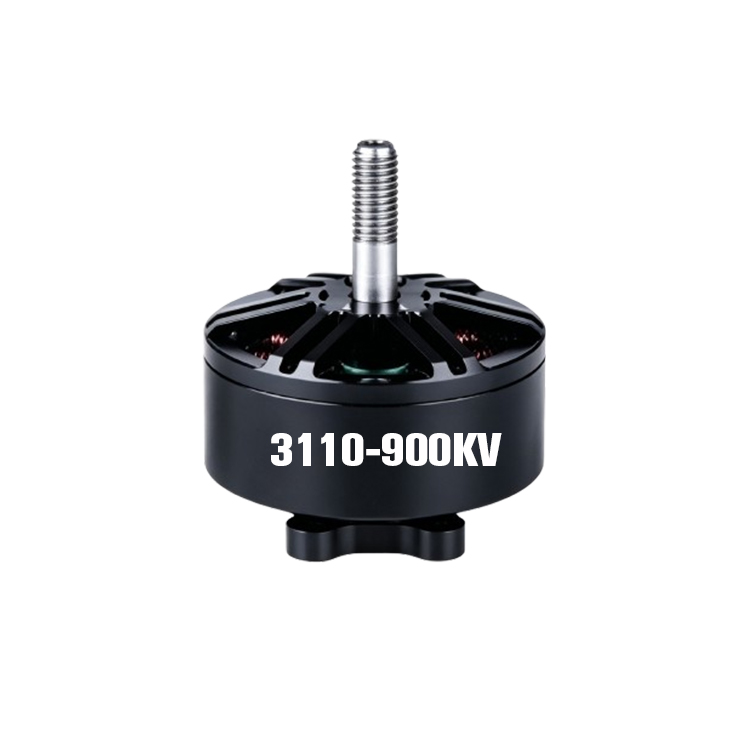
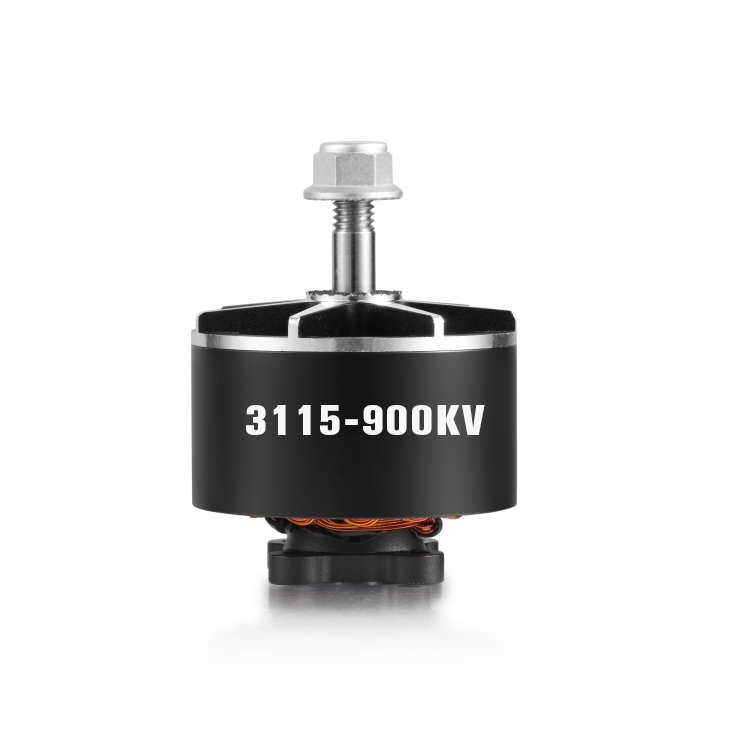
For this comparison, we'll look at the BGS-F3110 900KV and BGS-F3115 500KV. Both have a 900KV option, but their dimensions, weight, and published test configurations differ.
Let's first look at the specifications of these two BGS motors.
| Specification | BGS-F3110 900KV | BGS-F3115 900KV |
|---|---|---|
| Motor dimensions | 37.2 × 27.8 mm | 37.2 × 32.8 mm |
| Stator configuration | 31 × 20 mm | Approximately 30 mm stator diameter |
| Pole/slot configuration | 12N14P | 12N14P |
| Motor weight | 86 g | 112g |
| Published application direction | 9–11-inch FPV and high-load multirotors | 10-13inch Multirotors, aerial photography, industrial UAVs |
| Published 900KV test configuration | 9 × 5 × 3 | 10 × 5 × 3 |
These are real product examples, but the published configurations are not identical. The comparison illustrates motor selection principles rather than proving that one model outperforms the other.
Here is the interesting part: if both motors have the same KV, why can their performance still differ?
Think of KV as a clue about rotational speed, not a complete personality profile. Two people may run at the same speed on a track, but that doesn't mean they have the same strength, endurance, or ability to carry a heavy backpack. Motors are similar: the number tells you something important, but not the whole story.
The numbers in 3110 and 3115 typically indicate the stator diameter and height specifications; the 3115 has a taller stator. A larger effective stator volume generally helps increase electromagnetic torque capacity and provides more space for winding, heat dissipation, and load design; however, actual performance also depends on the magnetic circuit, windings, resistance, and heat dissipation structure.
Even with the same KV rating, the two motors may not be suitable for the same propeller. Propellers with larger diameters or greater pitch typically require higher load torque; therefore, current, input power, rotational speed, and temperature rise must all be evaluated together—rather than simply comparing maximum thrust.
Based on the weights listed on the official website, the 3115 is approximately 26 g heavier than the 3110, representing an increase of about 30%. For a quadcopter, the motors alone could add approximately 104 g (the total weight difference of the four motors).
If the 3115 can provide the additional thrust reserve required for actual missions, this extra weight may be justified; however, if the drone primarily performs light-load cruising missions, the weight advantage of the 3110 may be more valuable.
The published BGS-F3110 900KV test data provides a useful illustration of how operating conditions affect motor performance.
The following measurements were recorded using a 10 × 5 × 3 propeller under the listed 12S test configuration.
Accelerator | 3110 Current(A) | 3115 Current (A) | 3110 Efficiency (gf/W) | 3115 Efficiency(gf/W) |
|---|---|---|---|---|
40% | 4.30 | 7.60 | 6.60 | 5.24 |
50% | 8.12 | 12.80 | 5.20 | 4.54 |
60% | 14.08 | 20.70 | 4.30 | 3.81 |
70% | 20.25 | 29.10 | 3.80 | 3.53 |
80% | 29.73 | 41.10 | 3.30 | 3.10 |
90% | 40.85 | 55.20 | 2.80 | 2.73 |
100% | 54.47 | 71.30 | 2.50 | 2.46 |
This set of data reveals two noteworthy phenomena:
- At low to medium throttle levels, the 3110 delivers higher thrust per unit power. At 40% throttle, the 3110’s efficiency is 6.60 gf/W, while the 3115’s is 5.24 gf/W. However, due to differences in test voltage, this discrepancy cannot be entirely attributed to motor design.
- At high throttle settings, the efficiencies of the two motors gradually converge. At 100% throttle, the 3110 achieves 2.50 gf/W and the 3115 achieves 2.46 gf/W, showing a minimal difference; at the same time, the 3115’s thrust reaches 4,215 gf, which is approximately 24.4% higher than that of the 3110.
Even a well-designed motor cannot deliver its intended performance if the surrounding propulsion system is poorly matched.
Propeller matching: A larger-diameter or higher-pitch propeller generally increases torque demand and may substantially increase current consumption. The relationship depends on propeller geometry, RPM, and operating conditions, so the recommended propeller should be checked against actual motor test data.
ESC compatibility: The ESC must support the required current and voltage while providing suitable commutation and control. An undersized ESC or unsuitable settings can limit performance and introduce additional losses.
Battery voltage: A higher-voltage system can change the motor's available speed range and electrical operating point, but the result depends on the motor's winding, controller, and load. Battery voltage under load also matters because voltage sag can reduce available performance.
This is particularly relevant when comparing the F3120 and P3515X: their published test configurations use different voltage platforms. Their results should not be compared as if they were obtained under identical conditions.
The best motor is the one that meets the aircraft's mission requirements, not necessarily the one with the highest advertised power.
For large FPV and high-load multirotor platforms, the BGS-F3120 500KV is a candidate worth evaluating when a 9–11-inch propeller and a compatible high-voltage propulsion system are required. Engineers should assess its current draw and thrust across the intended throttle range, then confirm that the ESC, battery, and frame meet the system requirements.
For multirotor, aerial photography, and industrial UAV applications, the BG-P3515X 500KV provides another option to evaluate. Its motor dimensions, weight, and published test configurations should be considered alongside the aircraft's target thrust, available installation space, and operating voltage.
Neither model should be selected on KV alone. Before making a final decision, UAV manufacturers should compare:
Required thrust per motor at takeoff, hover, and maximum payload.
Current consumption and electrical power at the target thrust.
Motor and ESC temperature during sustained operation.
Propeller compatibility and available installation space.
Motor weight and its effect on the aircraft's total mass.
Battery voltage, flight duration, and the intended duty cycle.
For a meaningful comparison, engineers should test both motors at the same target thrust rather than simply comparing their maximum thrust figures. This reveals which motor requires less electrical power to produce the thrust the aircraft actually needs.
Two brushless drone motors with the same KV rating can deliver different results because KV describes only one aspect of their electrical characteristics. Winding design, stator dimensions, magnetic structure, current limits, cooling conditions, propeller selection, and ESC compatibility all contribute to the final performance.
The BGS-F3110 900KV and BGS-F3515 900KV illustrate why UAV manufacturers should examine the complete propulsion system before selecting a motor. Their published specifications provide a useful starting point, but a definitive performance ranking requires testing under equivalent conditions.
At BOGONG SUN (BGS MOTOR), effective motor selection begins with the actual application: target thrust, propeller dimensions, battery voltage, payload, and flight duration. By evaluating these requirements together, UAV developers can select a propulsion solution that balances thrust, efficiency, weight, and long-term operating reliability.
 what's app