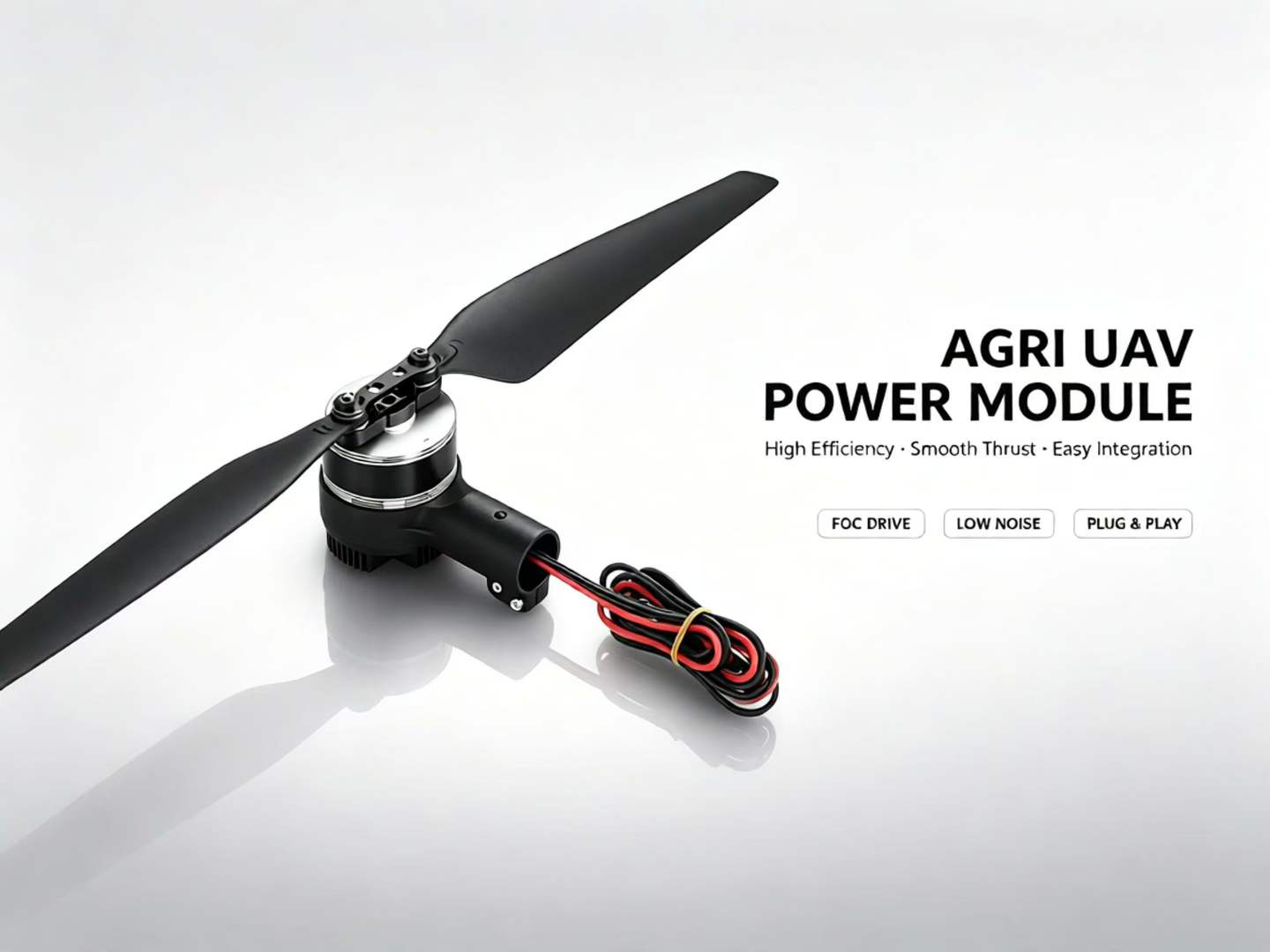
When you are developing a UAV, robot, or industrial power system, the motor is not an independent component. It needs to work together with the propeller, load, controller, and mechanical structure to form a complete drive system.
For applications that require high torque, precise speed control, and stable operation, FOC motor kits can be designed in different configurations, from single-shaft to dual-shaft and coaxial structures.
Although these configurations can all provide mechanical power, they have significant differences in motor layout, torque transmission, propeller arrangement, load distribution, installation space, and control requirements.
A single-shaft design uses one motor to drive one output shaft and one load, such as a propeller.
The structure is relatively simple, with a short power transmission path, making it easier to install, maintain, and control.
For UAV applications, the typical configuration is:
One motor + one output shaft + one propeller
The motor directly transfers torque to the propeller, so the motor KV, torque, speed, and propeller size need to be properly matched.
A dual-shaft design provides two output directions or two mechanical outputs from one motor structure, depending on the application.
Compared with a single-shaft design, it can provide more flexible power transmission and may reduce the number of individual motors required in certain mechanical systems.
However, the shaft structure, bearings, load distribution, and mechanical strength need to be carefully considered, especially when the system operates under high torque.
A coaxial system places two rotating power outputs on the same center axis.
In a UAV, a typical coaxial configuration uses two propellers positioned above and below each other, with the two propulsion units independently controlled.
The main advantage is that two propulsion outputs can be concentrated into a compact space without significantly increasing the overall lateral dimensions of the system.
The main differences can be understood from five aspects.
In a single-shaft system, each motor normally provides one independent propulsion point, and multiple motors are distributed across different positions of the equipment.
In a coaxial system, two propulsion units are concentrated along the same center axis.
Therefore:
Single-shaft designs focus on simple and independent power output, while coaxial designs focus on compact structure and higher power integration.
A single-shaft system normally drives one propeller, making the relationship between motor speed, torque, and propeller load relatively straightforward.
A coaxial system normally uses two propellers on the same axis. The two propellers rotate according to the designed configuration, so the system needs to consider not only the torque and speed of each motor but also the aerodynamic interaction between the upper and lower propellers.
This makes propeller selection and motor matching more important in a coaxial system.
In a single-shaft system, the output shaft normally carries one main mechanical load, resulting in a relatively straightforward mechanical structure.
A coaxial system needs to handle two rotating power outputs, so the design needs to consider axial loads, radial loads, bearing structure, shaft strength, and the interaction between the two propulsion units.
For high-torque applications, the mechanical strength of the shaft and bearings becomes particularly important because the motor torque must ultimately be transferred to the propeller and load.
Single-shaft systems require individual motors to be installed at different locations, so increasing the number of propulsion points may also increase the overall size of the equipment.
A coaxial system concentrates two propulsion units along one axis, which can significantly reduce the lateral space required.
Therefore, coaxial designs can be considered when installation space is limited and high power density is required.
A single-shaft motor is relatively straightforward to control because each motor independently controls its own speed and torque.
A coaxial system requires more coordinated control because the two propulsion units need to work together while maintaining their respective speed and torque according to the operating conditions.
This is one area where FOC control can be valuable.
FOC provides more precise control of motor current, torque, and speed, making it suitable for applications that require smooth torque output, precise speed control, and fast dynamic response.
A single-shaft solution is suitable when you need independent propulsion points and a relatively simple mechanical structure.
Typical applications include:
Agricultural UAVs
Industrial UAVs
Logistics UAVs
Multirotor drones
Fans and propulsion systems
Robot joints
Industrial rotating equipment
For example, a multi-rotor agricultural UAV can use several single-shaft motors, with each motor driving one propeller. The individual propulsion units work together to provide the total lift required by the aircraft.
The main advantage is that each propulsion unit operates independently, making system testing, control, and maintenance relatively straightforward.
A coaxial solution is suitable when you need two propulsion outputs within a limited installation space.
Typical applications include:
Coaxial UAVs
Heavy-lift UAVs
Specialized aerial propulsion systems
Compact propulsion systems
Equipment with strict lateral space limitations
Dual-propeller propulsion systems
For example, if you need additional propulsion without significantly increasing the lateral size of the UAV, a coaxial configuration can place two propellers on the same center axis.
The two propellers can be controlled independently, allowing the system to achieve a higher level of power integration within a limited space.
For high-torque motors, simply increasing motor power does not solve every system requirement.
When your equipment needs frequent starting, acceleration, deceleration, or rapid load changes, the motor needs to respond quickly while maintaining stable torque output.
FOC, or Field-Oriented Control, controls the motor current and magnetic field more precisely, which can help provide smoother torque output and better dynamic response, particularly during low-speed operation and changing loads.
For a coaxial UAV system, this becomes even more important because the upper and lower propulsion units may need coordinated control according to the aircraft's operating condition.
Therefore, a complete high-torque propulsion solution should be considered as a combination of:
High-Torque Motor + FOC Controller + Proper Propeller + Suitable Mechanical Structure
When selecting a high-torque FOC motor kit, start with your actual equipment requirements rather than only comparing motor specifications.
If you need one independent power output with a simple structure and convenient maintenance, a single-shaft solution may be suitable.
If you need two power outputs within a limited lateral space, a coaxial solution can be considered.
If your equipment requires high torque, precise speed control, and fast response, an FOC-controlled motor system can provide a suitable control solution.
For UAV applications, you should evaluate the complete relationship between:
Aircraft Weight → Required Thrust → Number of Motors → Propeller Size → Motor KV → Operating Voltage → Torque → FOC Control → Installation Structure
Only by considering these parameters together can you determine the motor configuration that fits your actual application.
The difference between single-shaft and coaxial high-torque FOC motor kits is not simply the number of motors. It changes the entire power layout, load distribution, propeller configuration, installation structure, and control requirements.
Single-shaft systems are generally suitable for independent propulsion and relatively simple mechanical structures, while coaxial systems are more suitable when you need compact installation, dual propulsion outputs, and higher power density.
For your application, the right configuration should be selected according to the load, propeller, installation space, operating voltage, torque requirement, and control requirements, rather than simply choosing a motor with a higher power rating.
 what's app