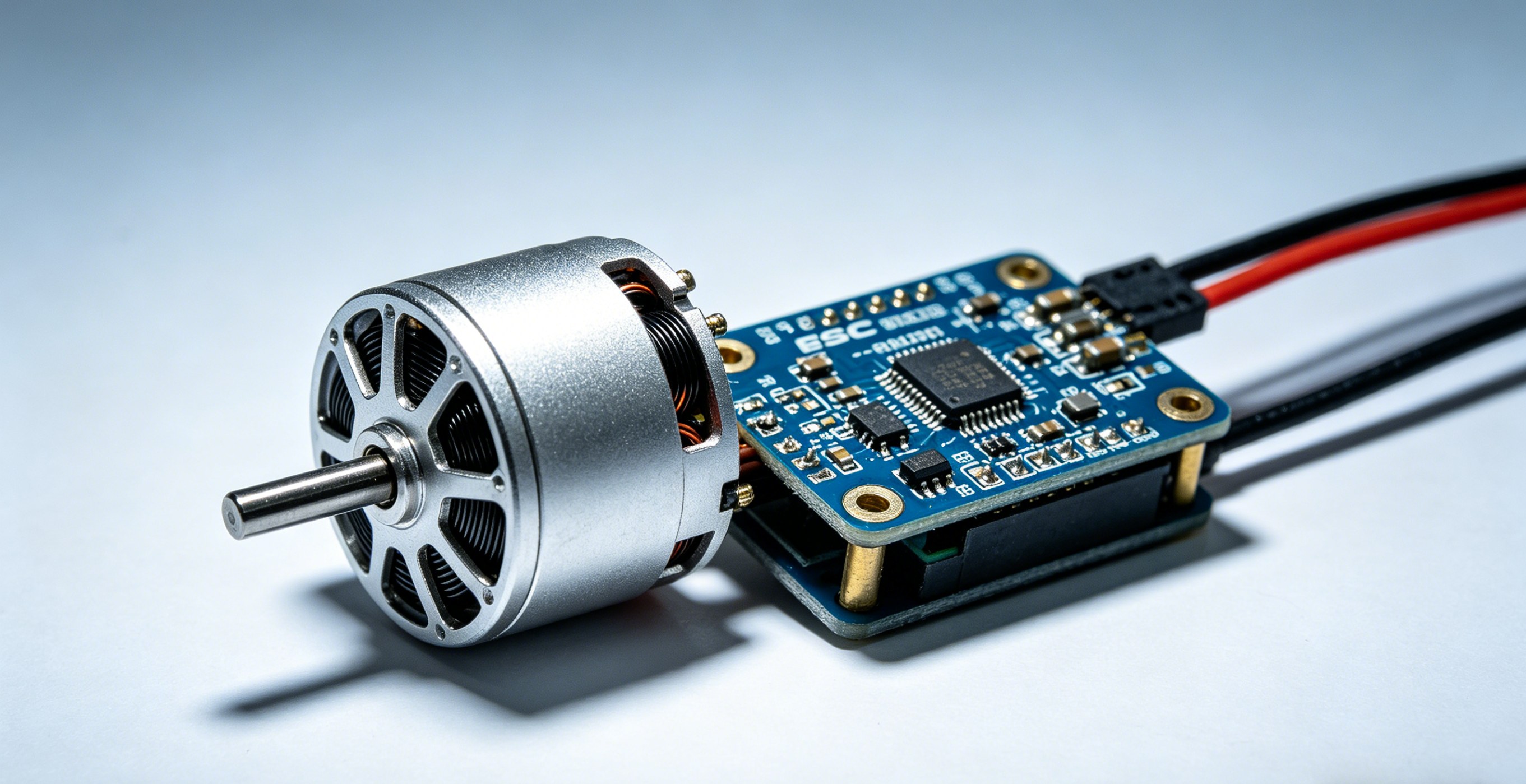
In the world of FPV drones, the power system is about more than just “making the motors spin.” It is a precisely coupled closed-loop system: the battery provides energy → the ESC (Electronic Speed Controller) converts commands → the motors output torque → the propellers generate thrust. An imbalance in any of these links can result in a sluggish flight feel or voltage sag at best, and at worst, it can directly burn out the ESC or even cause a fire in mid-air.
This guide will take you deep into the underlying logic and walk you through how to tune your power system like a professional pilot.
1. How an ESC Works
The core function of an ESC is to convert the battery’s direct current (DC) into three-phase alternating current (AC) and precisely control the motor’s speed based on signals from the flight controller (FC).
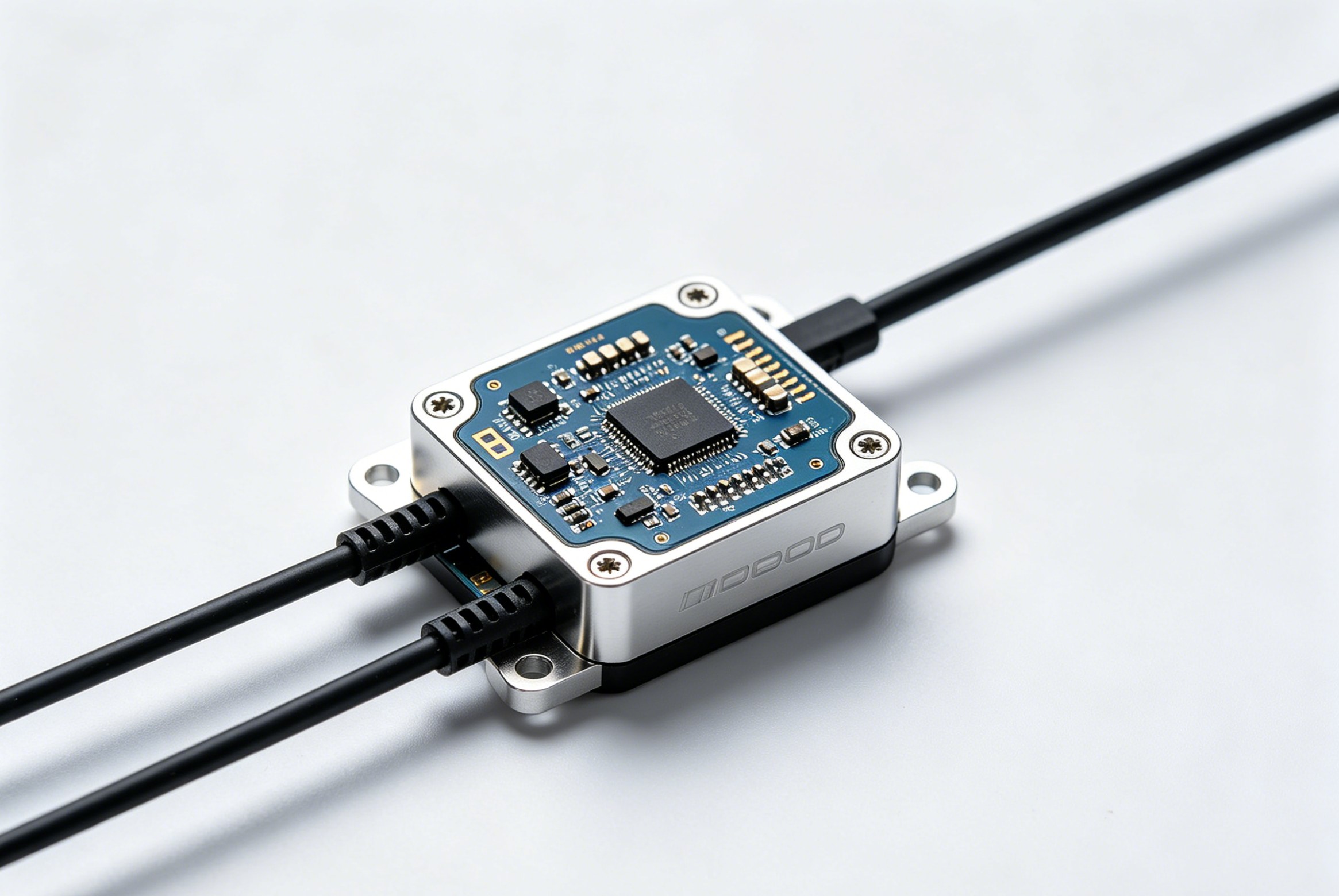
2. Physical Specifications: 4-in-1 vs. Single-Channel
4-in-1 ESC (Mainstream Choice): Integrates four ESC channels onto a 30.30mm or 20x20mm circuit board. Advantages include simple installation, a centralized center of gravity, and improved control response.
Single-Channel ESC (Specialized Use): Typically mounted on the arm. Although wiring is complex, it is still used in large payload applications or scenarios where maintenance costs are a concern.
3. Core Parameters: Current (Amps) and Voltage (Voltage)
Continuous Current: The upper limit at which the ESC can operate stably for extended periods.
Burst Current: Typically refers to the maximum current the ESC can withstand for 10 seconds.
Voltage Rating: Must match the battery (e.g., 2S–4S or 3S–6S). Important: Connecting a 6S battery to a 4S ESC will instantly burn out the MOSFETs (Metal-Oxide-Semiconductor Field-Effect Transistors).
Power system matching follows a “from the outside in” sequence: frame size → propeller size → motor KV/specifications → ESC current → battery capacity (C-rate).
1. Torque Matching Between Propellers and Motors
The motor must have sufficient torque to drive propellers of a specific size and pitch.
Large diameter/high pitch = High thrust but heavy load. Requires a large stator (e.g., 2806.5) and a low KV motor.
Small diameter/low pitch = Fast response but concentrated thrust. Requires high RPM (high KV) and a small stator (e.g., 2207).
2. Formulas for Voltage, KV, and RPM
Theoretical Maximum RPM = KV Value × Battery Voltage (V)
Low Voltage (4S/14.8V) + High KV: Strong burst of power, but extremely fast current draw; suitable for lightweight racing.
High Voltage (6S/22.2V) + Low KV: This is currently the gold standard. High voltage allows for the same thrust at lower current, significantly reducing heat loss and alleviating battery stress.
3. The “20% Safety Margin” for ESC Current
Calculation Method:
Consult the motor’s official test data sheet to find the maximum current at 100% throttle (assumed to be 40A).
Apply the margin formula: 40A × 1.25 = 50A.
Conclusion: You should select an ESC with a rated current of at least 50A.
Hardware determines the upper limits, while software (firmware) determines the level of precision in the control feel.
1. Protocol: DShot is the only true standard
Modern ESCs generally support DShot600 or DShot1200. This is a digital signal that requires no throttle travel calibration and offers extremely strong resistance to interference.
2. Firmware Ecosystem
BLHeli_32: Currently the most powerful closed-source firmware with the widest range of adjustable parameters.
Bluejay (an upgraded version of BLHeli_S): An open-source solution that supports Bidirectional DShot and enables RPM filtering, significantly improving flight smoothness.
3. PWM Frequency Selection
24kHz / 48kHz: Suitable for large drones or setups prioritizing torque.
96kHz: Suitable for micro drones (Whoops), significantly extending flight time and making flight sounds smoother, though it slightly sacrifices torque under extreme conditions.
Scene | Recommended Motor | KV (6S allocation) | Paddle | ESC specification | Key Features |
5"racing | 2207 / 2306.5 | 1950KV | 5.1" Three-blade paddle | 55A+ | Extremely high burst performance, at the cost of endurance. |
5inch flower in flight | 2306 | 1750KV | 5.0" Three-blade paddle | 45A - 50A | The feel is smooth and linear, with balanced power output. |
Long endurance/air photography | 2806.5 | 1300KV | 7" Two-blade paddle | 40A - 50A | High efficiency, low rotational speed |
Mini Whoop | 0802 / 1102 | 18000KV+(1S) | 40mm | 5A - 12A | Extreme lightweight |
Low-ESR Capacitor (Mandatory!): ESCs generate massive voltage surges when switching motor phases. Soldering a 35V 1000uF electrolytic capacitor (for 6S) to the power supply pads can effectively prevent the ESC from burning out and reduce screen snow.
Screw Length Check: This is the most common mistake made by beginners. When installing the motor, if the screws are too long, they will contact the internal windings, causing a short circuit and instantly burning out the ESC.
Active Braking (Damped Light): Ensure this feature is enabled. It allows the motor to decelerate rapidly when you release the throttle, providing racing-style braking feedback—the foundation of precise control.
Soldering Quality: Power wires (XT60) must be fully soldered through. Cold solder joints can overheat or even detach under high current, causing the aircraft to stall in mid-air.
After assembly, perform a 30-second aggressive test flight and check immediately upon landing:
If the motor is too hot to touch and the ESC is warm: This indicates that the propellers are too heavy or the KV rating is too high.
Motor is ice-cold & ESC is extremely hot: This indicates a failed electrolytic capacitor or incorrect firmware settings (such as excessive lead angle).
Both are lukewarm: Congratulations! This power system has achieved the optimal balance between performance and longevity!
 what's app